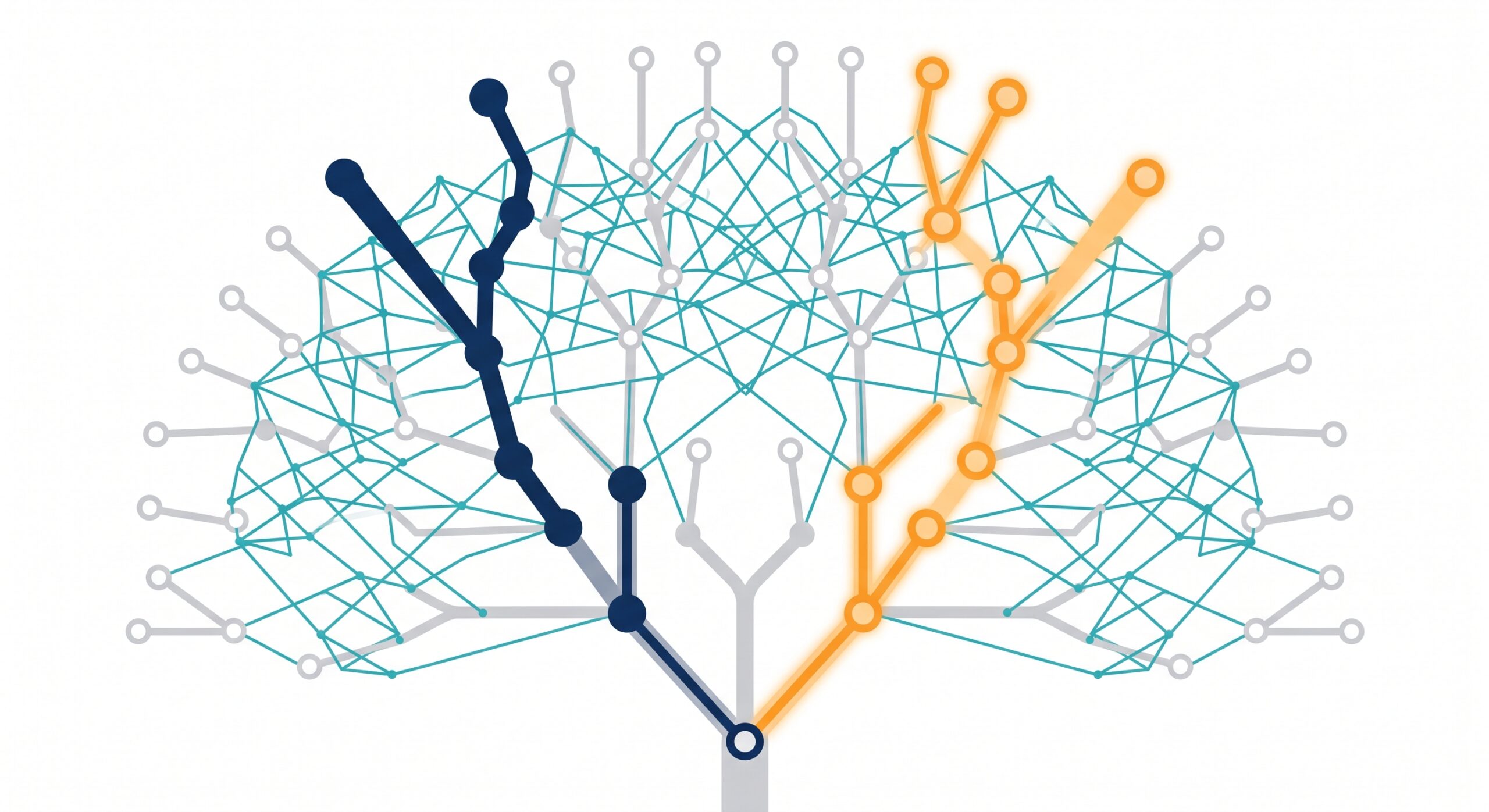
A single autosomal DNA test can give you a large list of cousin matches, ethnicity estimates and suggested tree connections. As your research moves back beyond the 4th or 5th generation, however, the limits of autosomal DNA become more apparent. Because autosomal DNA is shuffled by recombination in every generation, and the expected share you inherit from any one ancestor roughly halves with each generation, it becomes harder to connect a match to a specific distant ancestor. When a specific research question calls for it, complementary tests can add evidence that autosomal DNA alone cannot provide.
Combining DNA tests for genealogy means looking at a question from more than one angle. Autosomal DNA maps your overall cousin network, while Y-DNA and mtDNA follow your direct paternal and direct maternal lines and are largely non-recombining. This article is Part 5 of our Getting Started with DNA Testing for Genealogy series. It explains how the three test types complement each other, introduces common reasons DNA evidence can be misleading—including endogamy and pedigree collapse—walks through three illustrative research scenarios, and helps you decide whether an additional test is justified for your question. The approach throughout is a structured research approach: it organizes the evidence and the hypotheses, but it does not promise a single clear answer in every case.
- Autosomal DNA covers all ancestral lines, but each generation back makes it harder to tie a match to one ancestor.
- Y-DNA and mtDNA each describe one direct line, so they suit specific questions rather than general sorting.
- Different DNA tests provide complementary evidence, but each has limitations.
- Endogamy and pedigree collapse can create multiple ancestral paths to the same DNA match and may increase shared DNA.
- A DNA result supports a hypothesis. Documents and independent evidence are needed before you add it to your tree.
- Check each provider's current rules and privacy terms before you upload genetic data.
The three test classes answer different kinds of questions:
| Test Class | Inheritance Path | Recombination? | Primary Genealogical Use |
|---|---|---|---|
| Autosomal | Maternal & Paternal (all ancestral branches) | Yes (random mix) | Finding cousins within roughly 5 generations, testing your overall tree |
| Y-DNA | Direct paternal (father's father...) | Essentially none (passed on largely intact; changes only by occasional mutation) | Surname projects, direct paternal-line questions |
| mtDNA | Direct maternal (mother's mother...) | Essentially none (passed on largely intact; changes only by occasional mutation) | Direct maternal-line questions, haplogroup origins |
Combining DNA Tests and Understanding Their Limitations
Nuclear DNA consists of your autosomes and sex chromosomes, while mitochondrial DNA is extranuclear. An autosomal DNA test examines DNA inherited through all of your ancestral lines: you have 256 sixth-great-grandparents, although because of recombination you inherit detectable DNA from only a subset of them. This makes autosomal DNA effective for finding recent cousin connections, but a shared segment on its own often cannot be tied to one specific ancestor without further evidence, such as documented trees, segment mapping and matches from several relatives. To review the mechanics of autosomes, see our guide to understanding autosomal DNA testing (Part 2).
Y-DNA and mtDNA add a lineage-specific line of evidence. The Y chromosome (passed father to son) and mitochondrial DNA (passed mother to children) are inherited largely without recombination (apart from small regions at the tips of the Y chromosome). They change only slowly through occasional mutations and can remain identical or nearly identical across many generations. Used together with autosomal data and documents, they can help you assess whether a match is consistent with your direct paternal line or your direct maternal line. Each of them, however, describes only one line out of your whole pedigree.
When DNA Results Can Be Misleading
DNA results are powerful evidence, but the amount of shared DNA does not always translate neatly into one genealogical relationship. Family structures, population history and the way relationships overlap can affect how a match should be interpreted. Two concepts are especially useful to recognize at this introductory stage: endogamy and pedigree collapse.
Endogamy: repeated relationships within a population
Endogamy occurs when people in a community or population have frequently formed relationships within that same group over many generations. As a result, two people may be related through several different ancestral couples, rather than through just one recent shared ancestor. Their shared DNA can therefore reflect multiple lines of descent. In some endogamous populations, this can make matches appear genetically closer than a single-path family-tree relationship would suggest.
Pedigree collapse: the same ancestor in more than one place
Pedigree collapse happens when the same person appears more than once in an individual's family tree because relatives in earlier generations had children together. The number of distinct ancestors is then smaller than a simple doubling model suggests. Pedigree collapse can occur in any population; it is not automatically evidence of long-term endogamy, although the two can overlap.
Why shared DNA amounts can be elevated
When several ancestral paths connect two people, DNA inherited through those different paths may contribute to their total shared amount. A match may therefore share more centimorgans (cM) than expected for the most recent relationship shown in a simplified family tree. This does not mean every high cM value is caused by endogamy: the range of DNA shared by ordinary relationships already varies, and pedigree errors, multiple relationships and other family-history circumstances may also matter.
Different tests provide different evidence
Autosomal DNA can reveal connections across many branches, while Y-DNA and mtDNA address one direct paternal or maternal line respectively. These tests are not interchangeable, and a result from one test does not automatically confirm a conclusion suggested by another. In an endogamous family network, lineage-specific results may help investigate a particular direct line, but they do not remove the complexity of the wider pedigree.
At this stage, the key lesson is simply to avoid interpreting a shared cM total as a precise relationship label. Check family trees for repeated ancestral couples and consider whether a population has a history of endogamy. Advanced methods for identifying and analyzing endogamous matches belong in a dedicated match-interpretation lesson. For a deeper explanation, see our guide to endogamy in genetic genealogy (when available).
Three Illustrative Research Scenarios
The three scenarios below are illustrative examples created for teaching purposes. The names, places, dates and match values are invented and do not describe real cases. In each scenario, a DNA result supports a hypothesis; it does not by itself prove a relationship.
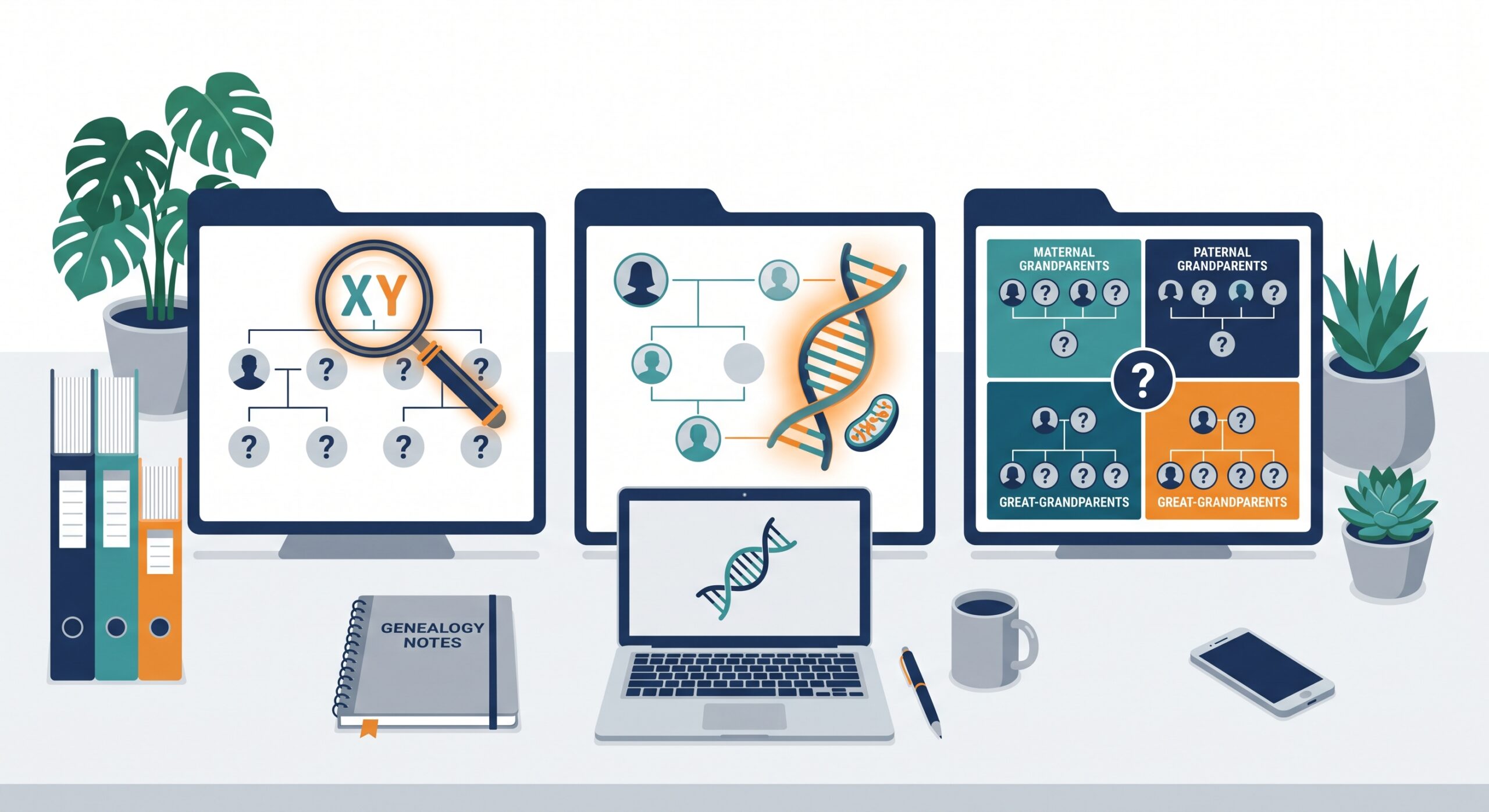
Scenario 1: A Paternal Surname Question (Autosomal + Y-DNA)
Imagine your paper trail ends in 1840 with a great-great-grandfather named William Miller. Because "Miller" is a common surname, census searches and parish indexes leave you with five candidate families in the county. You have hundreds of autosomal cousin matches, but the shared DNA is diluted and you cannot tell which Miller family is yours.
The multi-test approach: You test a close male Miller relative (or yourself, if you are a male-line descendant) with a Y-DNA test such as Y-111 or Big Y-700, and look at the results in the Miller Surname DNA Project on FamilyTreeDNA. Suppose the results show a shared terminal SNP with documented descendants of one of the five candidate families. That is a useful lead, and you can then check whether autosomal cousins who descend from that same family also appear in your match list.
What this can and cannot show: A Y-DNA match or a shared terminal SNP indicates a common paternal-line ancestor. It does not on its own identify a particular historical person, and it does not prove that your line carried the Miller surname all the way back. The result has to be weighed against the matches' documented paternal lines, the resolution of the tests, the number of mutations separating the testers, and alternative explanations such as an unrecorded adoption or a surname change.
Documentation that would strengthen or weaken the hypothesis:
- Strengthens: a will, deed or probate record placing a William Miller in the candidate family's household in the 1830s; a baptism or marriage record naming his father; matches whose documented lines lead to the same family and whose Y-DNA distance fits the expected time span.
- Weakens: an equally close Y-DNA match to a different Miller family; a gap or unsourced link in a match's documented paternal line; no autosomal cousins from the candidate family; or records showing that a William Miller in that family died before 1840.
Review the details of paternal inheritance in our Y-DNA testing guide (Part 4).
Scenario 2: A Maternal Maiden-Name Gap (Autosomal + mtDNA)
Tracing maternal lines is often difficult because women usually took their husbands' surnames, so maiden names may be missing from many records. Suppose your 3rd-great-grandmother appears in records only as "Sarah", and her parents cannot be identified from documents alone.
The multi-test approach: You find a living descendant of Sarah through an unbroken chain of mothers and sponsor an mtDNA full-sequence test. Suppose the result is an exact match (genetic distance 0) to another tester whose documented maternal line leads to a family named "Green" in the same parish. You then look through your autosomal matches for people who descend from that Green family and share an amount of DNA with you, for example 40 cM.
What this can and cannot show: An identical mtDNA result is compatible with a shared direct maternal ancestor, but because mtDNA changes so slowly, that ancestor may have lived many generations earlier than Sarah. It does not show that Sarah's maiden name was Green. A match of about 40 cM is consistent with several different relationships, and it does not have to come through the maternal line at all. Treat "Sarah Green" as a preliminary hypothesis until documents, documented family lines and independent DNA evidence point the same way.
Evidence that would raise confidence: a baptism, marriage or probate record naming Sarah's parents; a will naming a daughter Sarah with the right husband; autosomal matches who triangulate on a segment shared with several Green descendants; and a documented line from Sarah's family to the mtDNA match that is consistent in place and period. Review maternal inheritance pathways in our mtDNA testing guide (Part 3).
Scenario 3: Adoption and Unknown Biological Parentage
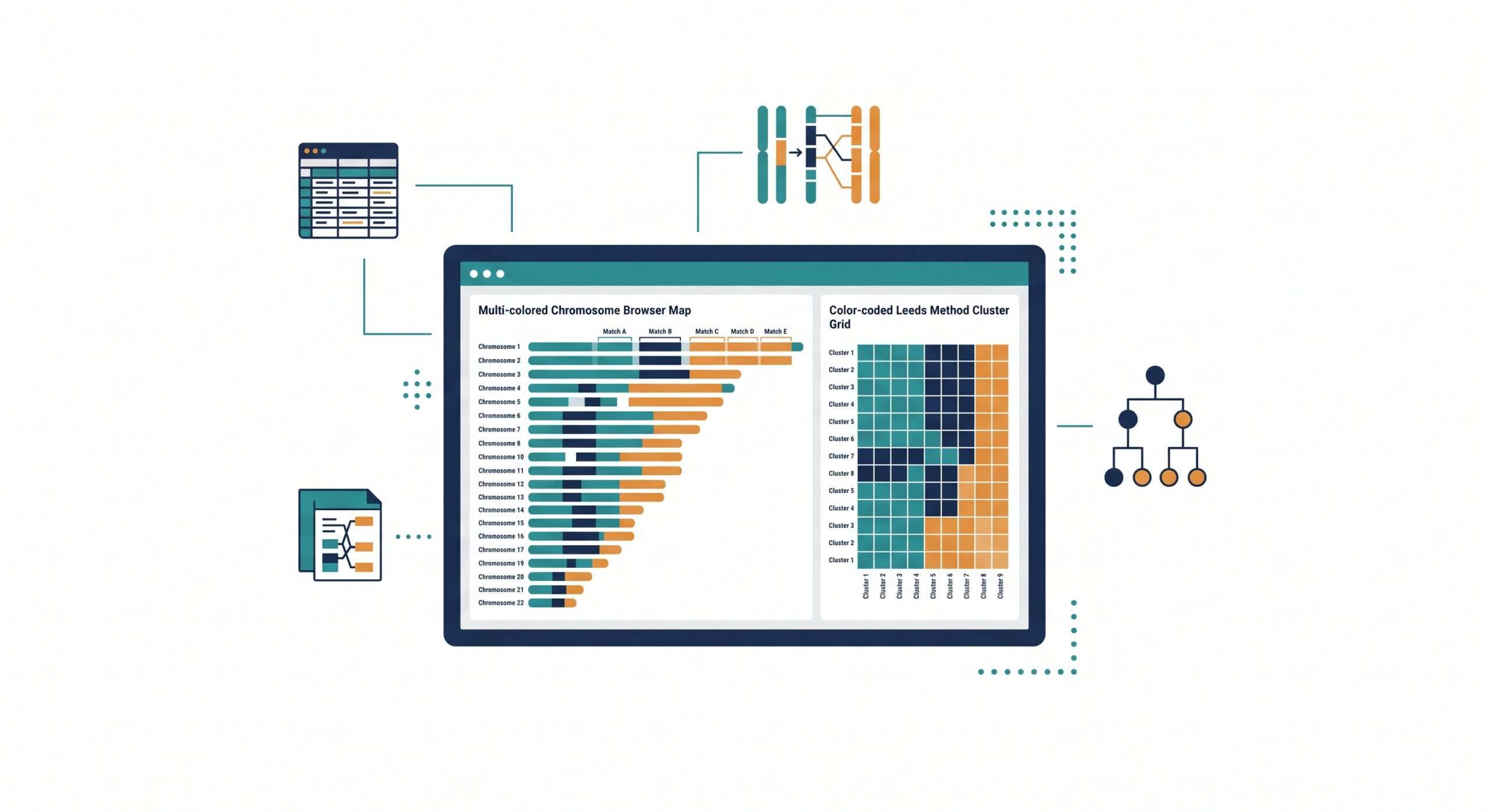
For adoptees and others searching for biological parents, a structured research approach usually starts with autosomal matching combined with documented genealogical research. A match list can contain thousands of people, so the work consists of grouping matches into clusters, building trees for the closest matches, and looking for ancestors or ancestral couples that the clusters have in common.
Different DNA tests give complementary information, but none of them automatically identifies an unknown parent. A parent is identified by interpreting several clues together, proposing one or more candidate families, and then testing each candidate against records and independent evidence. In some cases the evidence stays inconclusive.
A possible working model: four grandparent branches. When there is enough match data (several close and moderately close matches, and trees that can be built or reconstructed), it can help to sort matches into up to four provisional groups, one for each of the biological parents' parents. This is a way of organizing the evidence and forming hypotheses, not a guaranteed result. With few matches, overlapping groups, thin trees or endogamy, matches often cannot be sorted cleanly, and some groups may remain empty or unexplained.
Where Y-DNA and mtDNA fit: They are supplementary tools for specific direct lines. A Y-DNA test can reveal surnames and families on the testing male's direct paternal line, and an mtDNA test describes his or her direct maternal line. They are not general filters that automatically divide your matches into four grandparent branches, and neither of them names a parent on its own. Autosomal clustering and tree-building remain the main way of sorting matches into the paternal and maternal sides and into grandparent branches, as far as the data allows. Relationship probability tools such as What Are the Odds (WATO) can then help test which positions in a candidate tree fit the amount of DNA shared.
What limits certainty:
- Match density: in a population or database with few testers, there may be too few close matches to build on.
- Endogamy: when ancestors were related to each other several times over, shared DNA totals are inflated and relationships appear closer than they are (see the ISOGG Wiki entry on endogamy).
- Unknown relationships: half-relationships, unrecorded adoptions and unexpected parentage in matches' trees can lead you to the wrong common ancestor.
- Incomplete trees: many matches have no tree or a very small one, so ancestors have to be reconstructed from records.
- Provisional clusters: a cluster is a pattern in the data, not a finding. It can contain matches from more than one branch, or split one branch into several.
This is a way to structure an investigation, not a procedure that is guaranteed to reach an answer. Cluster-based sorting depends on how many matches you have, how complete their trees are and how accurately the relationships are interpreted. A candidate parent should only be treated as identified when several independent lines of evidence agree, and the reasoning should be written down so that others can check it. The Genealogical Proof Standard describes one widely used framework for that.
Explore these strategies in our dedicated guide to DNA testing for adoptees.
Results from different tests and companies are hard to hold in your head. Use a research log to record each match, the test it came from, the documented line and the source. Tools such as DNA Painter can help you map specific chromosome segments to ancestral couples. Our free genealogy templates include spreadsheets for tracking autosomal, Y-DNA and mtDNA findings side by side.
Deciding Whether an Additional Test Is Justified
Additional tests cost money and, in the case of Y-DNA and mtDNA, depend on finding the right person to test. The table below links common research questions to a sensible starting point and to the tests worth considering as a complement.
| Research question | Start with | Consider as a complement |
|---|---|---|
| Finding unknown cousins | Autosomal DNA | An additional match database where possible |
| Investigating a direct paternal line | Autosomal DNA and documents | Y-DNA, if a suitable test person exists |
| Investigating a direct maternal line | Autosomal DNA and documents | mtDNA from a person in the unbroken maternal line |
| Investigating unknown biological parentage | Autosomal matches | Y-DNA or mtDNA when a specific line can be investigated |
Which test is right depends on three things: which relatives are available to test, which line you are investigating, and what documentation you already have. A Y-DNA test needs a male-line descendant of the ancestor in question, such as a brother, a paternal uncle or a male cousin connected through an unbroken chain of fathers. An mtDNA test needs a descendant connected to the ancestor through an unbroken chain of mothers (sons can be tested, but they do not pass mtDNA on). If neither person is available, or if documents already answer the question, an additional test may add little.
Choosing a Testing Company and Using Raw-Data Transfers
No single company is the right choice for every question. Compare providers on four points: your research goal, the match database that is relevant to your ancestry, the cost, and the tools available. Company policies on accepting uploaded raw data, on free versus paid features, and on data deletion change over time, so check each provider's current rules before you buy a kit or upload a file.
Three things are easy to confuse and should be checked separately: whether a provider accepts a transferred file, whether you can see your matches for free, and whether you need to pay for advanced analysis tools. Being able to do the first does not guarantee the other two.
Policy snapshot: The upload status above was checked against the providers' official documentation on October 23, 2026. These entries cover whether third-party raw DNA files can be uploaded; they do not guarantee free access to every match or analysis tool. Supported file versions, privacy options and service rules can change, so use the linked provider page as the final check before transferring data.
For the exact rules on file transfer, data access, deletion and privacy, read each provider's own documentation (terms of service, privacy statement and help pages) instead of relying on a general guide. For an independent overview of the test types offered, see the ISOGG autosomal DNA testing comparison chart or our genealogy resources directory. Note that a general ISOGG page cannot confirm a company's current upload policy.
Genetic data is personal and cannot be changed if it is exposed. Before uploading a raw-data file to any third-party service, read the provider's privacy policy and terms: who can see your matches, whether data may be shared with law enforcement or researchers, how long data is kept, and how you can delete it. Your DNA also carries information about your relatives, so consider their wishes, and never upload another person's data without their consent. You do not have to upload your data to every available platform.
Marketing sometimes suggests that a single DNA test will reveal your whole family tree. In practice, an autosomal test provides data that must be interpreted together with family trees and historical sources, and in some cases with targeted Y-DNA or mtDNA tests. Always check genetic hypotheses against original civil vital registers and parish records. Find the right archive for your ancestor in our global genealogy resources by country directory.
Frequently Asked Questions About Combining DNA Tests
Can I upload Y-DNA or mtDNA results to GEDmatch?
GEDmatch is designed primarily for autosomal DNA comparison and segment analysis. It is not the place to compare detailed Y-STR marker lists (such as Y-111) or full mtDNA sequences. Those comparisons are done mainly within FamilyTreeDNA's databases and its surname and haplogroup projects. Check GEDmatch's current documentation for exactly what it accepts.
Is it worth doing Y-DNA or mtDNA if autosomal DNA is so much cheaper?
It can be, if you have a specific, lineage-focused question and a suitable test person. If you are trying to find cousins within about 4 generations, autosomal DNA is usually sufficient. If you are trying to trace a direct paternal line further back, autosomal DNA is often uninformative because shared segments become small and increasingly unlikely to be inherited at all. Y-DNA is one of the few tools that can link male-line relatives across those deeper centuries, although results still have to be interpreted together with documentary evidence.
How do I test a maternal grandmother’s line if she has passed away?
You do not need her own DNA. Because mitochondrial DNA is passed down the direct maternal line with very few changes, anyone who descends from her through an unbroken chain of mothers carries essentially the same mtDNA as she did, apart from rare mutations. You can test yourself (if you are her daughter's child), her living daughter, her daughter's daughter, or her sister's daughter's daughter, for example.
Work through these steps before ordering additional tests:
- Write down the specific question and decide whether it concerns a direct paternal line, a direct maternal line or another branch.
- Collect the documents you already have for that ancestor, and note what they can and cannot answer.
- Start with autosomal DNA and compare providers on research goal, relevant match database, cost and tools. Check current upload and privacy rules before transferring any data.
- For a direct paternal question, identify a male-line relative who could take a Y-DNA test. For a direct maternal question, identify a person in the unbroken maternal line who could take an mtDNA test.
- Record every match, haplogroup and source in your research log (see our free genealogy templates), and treat conclusions as preliminary until documents and independent evidence agree.
Choosing the Right DNA Tests for a Genealogy Question
Combining DNA tests is most useful when it is driven by a clear question. Autosomal matches, a Y-DNA or mtDNA result and documentary records each answer a different part of that question, and a conclusion is strongest when all three point the same way. Where they do not, the disagreement is worth investigating before you add anything to your tree.
Continue with Part 6 of our series: Practical Steps to Start DNA Genealogy, which covers the workflow for ordering, taking and analyzing your first tests. If you want to evaluate relationships statistically, use our online DNA Relationship Calculator.
Sources and Further Reading
Sources are grouped by type. Check each source against the specific statement it supports.
Scientific and reference sources
- National Human Genome Research Institute (NHGRI): Mitochondrial DNA – genetics glossary entry.
- ISOGG Wiki: Haplogroup – definition of Y-DNA and mtDNA haplogroups.
- ISOGG Wiki: Endogamy – background on how endogamy affects the amount of shared DNA.
Method guides and tools
- ISOGG Wiki: Paths of DNA inheritance – how autosomal DNA, Y-DNA and mtDNA are passed down.
- ISOGG Wiki: Autosomal DNA statistics – expected shared DNA by relationship.
- The Shared cM Project (Blaine Bettinger), interactive tool at DNA Painter – possible relationships for a given amount of shared DNA.
- DNA Painter: Tools for genetic genealogy – includes the What Are the Odds? (WATO) tool.
- ISOGG Wiki: Autosomal DNA testing comparison chart – overview of tests from major companies (not a source for current upload policies).
Provider documentation: raw-data uploads
- AncestryDNA Help: Downloading DNA Data – states that DNA data from other websites cannot be uploaded to Ancestry.
- MyHeritage Help Center: Can I upload an autosomal DNA file? – confirms third-party uploads are no longer supported.
- FamilyTreeDNA: Autosomal DNA Upload – lists currently supported third-party file versions.
- 23andMe: How to Be Careful With Your Raw DNA Data – explains that third-party raw-data uploads to 23andMe are not supported.
- GEDmatch: How It Works – describes its raw-data upload and comparison process.
Provider upload policies in the table were checked on October 23, 2026. Re-check the linked official documentation before uploading, because accepted formats and policies may change.
Research standards and the limits of the method
- Board for Certification of Genealogists: Genealogical Proof Standard – a framework for judging how reliable a genealogical conclusion is. It is a general research standard and not specific to DNA.
- FamilySearch: Understanding the Genealogical Proof Standard – an introductory explanation of the same framework.
The scenarios in this article are invented teaching examples. No source above supports the specific people, places or match values used in them.