For family historians, tracing the direct paternal line is often deeply connected to the study of surnames. In many Western cultures, surnames are passed down from fathers to their children, mirroring the transmission of the biological Y-chromosome in an unbroken chain from father to son. However, even the most meticulous paper trails are vulnerable to missing parish records, burned court houses, or unrecorded non-paternity events (such as informal adoptions or undisclosed parentage). When traditional historical records fall silent, Y-DNA testing for genealogy offers an extraordinary biological tool to test your paternal pedigree and help break through brick walls.
Unlike autosomal DNA, which is inherited from all ancestors and dilutes rapidly with each generation, the Y-chromosome is passed down along the direct paternal line. Across most of its length, it does not recombine with the X-chromosome, so it passes from father to son virtually unchanged, which allows researchers to compare paternal lines across many generations. Occasional copying "mistakes" (mutations) still occur, and those small changes are exactly what make comparisons informative. In this comprehensive guide—which serves as Part 4 of our Getting Started with DNA Testing for Genealogy series—we will examine the biological mechanics of Y-chromosomal inheritance, clarify the crucial differences between STR and SNP markers, and show you how to strategically use paternal haplogroups and Surname Projects to investigate your toughest family history mysteries.
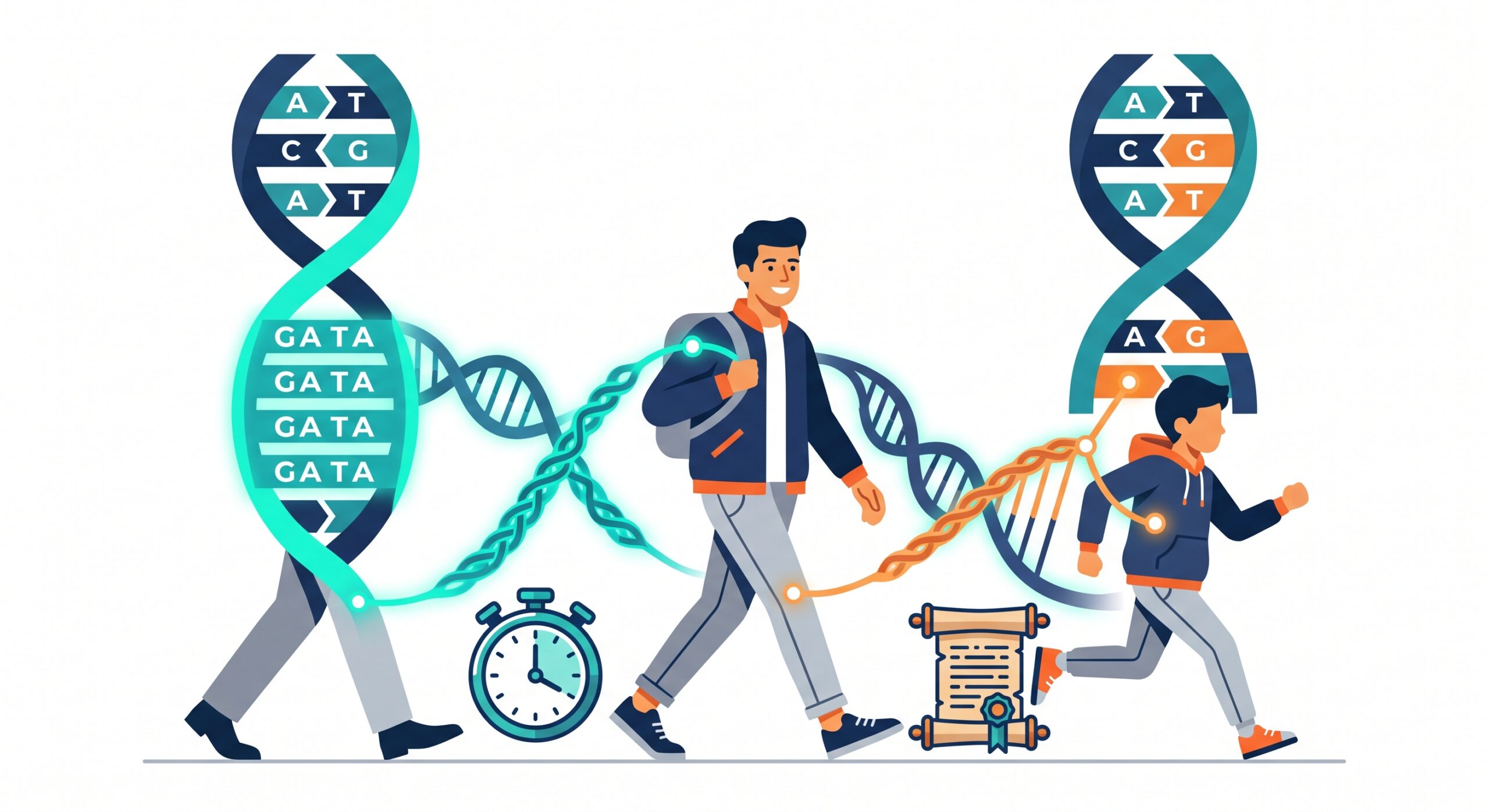
The transmission of the Y-chromosome is strictly paternal:
- Who has it: Only biological males carry the Y-chromosome (XY). Biological females do not carry a Y-chromosome (XX).
- Who passes it: Only biological fathers can pass the Y-chromosome to their sons.
- Female research strategy: If you are a female genealogist wishing to research your direct paternal line (your father's surname line), you cannot test your own DNA. Instead, you can sponsor a male relative from that direct paternal line—such as your biological father, brother, paternal uncle (your father’s brother), or male-line first cousin (the son of your father’s brother)—to take a Y-DNA test on your behalf.
Because of this direct inheritance path, Y-DNA is one of the best biological tools for surname research.
What is the Y-Chromosome and How is It Inherited?
Inside human cells, the 23rd pair of chromosomes determines biological sex. While females inherit an X-chromosome from each parent (XX), males inherit an X-chromosome from their mother and a Y-chromosome from their father (XY). The male-specific region of the Y-chromosome (MSY) comprises roughly 95% of its total length and does not recombine with the X-chromosome during reproduction.
When an autosomal DNA test is performed, the genetic segments are chopped up and blended every generation. To review how autosomes recombine, see understanding autosomal DNA testing (Part 2). In contrast, the Y-chromosome is passed down virtually unchanged from father to son, generation after generation. A man therefore carries a nearly identical copy of the Y-chromosome carried by his father, his paternal grandfather, and his more distant paternal ancestors. "Nearly" matters: each generation has a small chance of a new mutation, and those accumulated mutations are what allow us to tell paternal lines apart.
STR vs. SNP Testing: The Two Pillars of Y-DNA
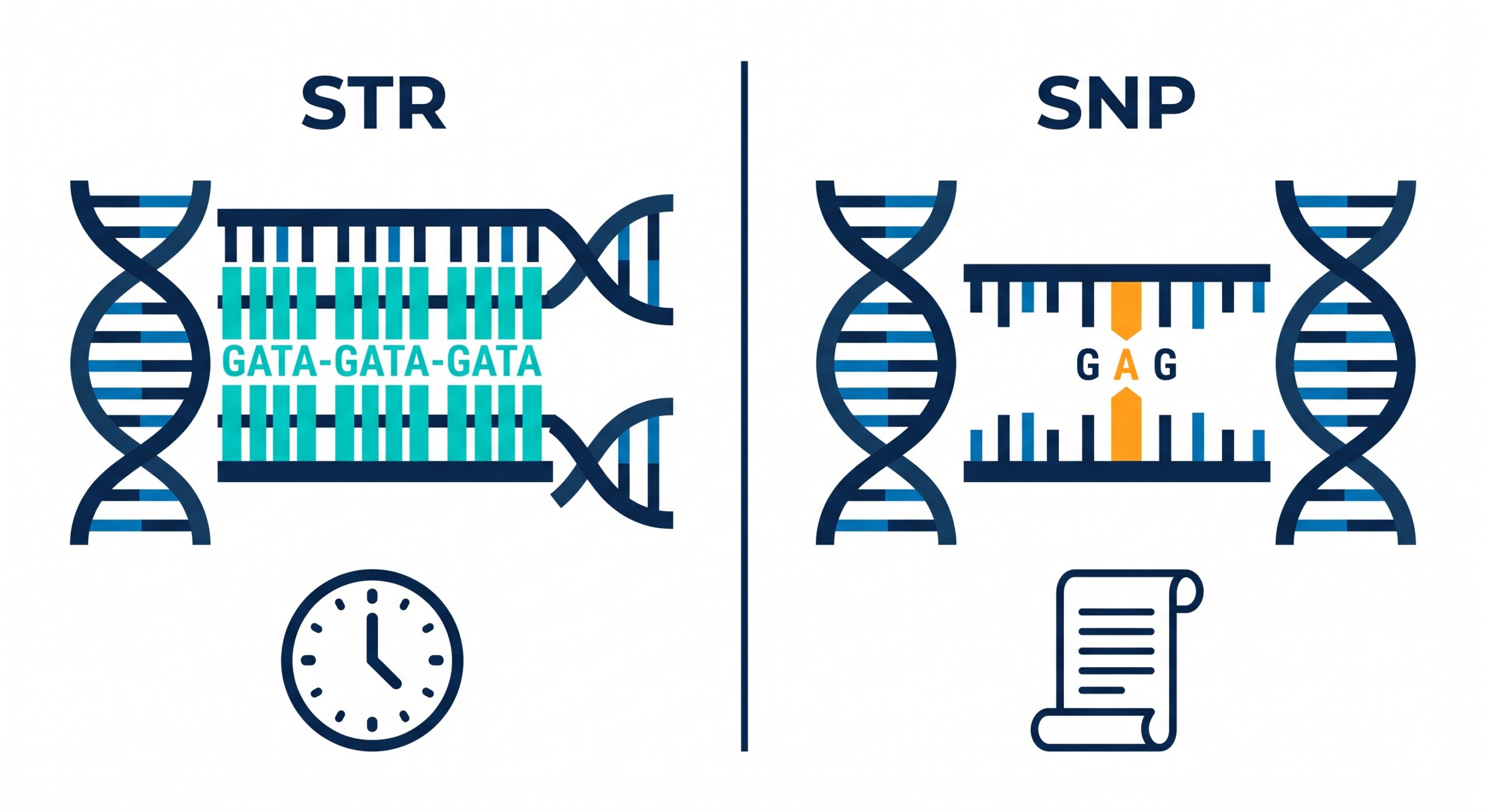
To use Y-DNA testing for genealogy effectively, you must understand the two distinct classes of genetic markers analyzed by testing laboratories: STRs and SNPs. They change at very different speeds and answer different genealogical questions. In general, STR results give you a haplotype (a set of numbers used to compare close paternal relatives), while SNP results place you on a haplogroup branch of the global paternal tree.
1. STR (Short Tandem Repeat) Testing
STRs are places on the Y-chromosome where a short DNA sequence is repeated several times in a row. Each Y-STR location has a name starting with "DYS" (DNA Y-chromosome Segment), and the number of repeats at that location is its value. For example, at the marker DYS393, a sequence such as "AGAT" might repeat 12 or 13 times depending on the man. ISOGG describes these markers as lying in non-coding DNA, meaning they are not known to affect health or appearance.
Occasionally, when a father passes his Y-chromosome to his son, the copying process adds or drops one repeat. That change is a mutation, and it is inherited by the son's male-line descendants. Because Y-STR mutations are relatively frequent compared with SNPs, they are useful for comparing men over genealogical timeframes. Mutation rates differ from marker to marker, and mutations are random, so two close relatives may differ while two distant relatives may match.
- How they are measured: At FamilyTreeDNA (FTDNA), dedicated STR tests are sold in panels such as Y-37 and Y-111. The Big Y-700 test is mainly a SNP and sequencing test; it also reports hundreds of additional STRs, but it is not an "STR tier" in the same sense.
- What they reveal: By comparing your STR values with another tester, you can calculate your genetic distance (the number of differences between your two results; see the next sections).
- Typical use case: Testing whether two men with the same surname (or a variant) plausibly share a paternal ancestor within the surname era.
- Main limitations: Mutation rates vary by marker, a repeat count can change back or change independently in unrelated lines, and unrelated men can sometimes share similar values. STR results alone cannot name an exact common ancestor.
2. SNP (Single Nucleotide Polymorphism) Testing
SNPs are changes to a single "letter" (nucleotide) at one position in the DNA sequence. According to ISOGG, the mutation rate for an individual SNP is extremely low, which is why SNPs work well for mapping the branches of the human paternal tree. Once a SNP mutation appears in a man's Y-chromosome, it is normally inherited by his male-line descendants, so it acts as a stable marker of that branch.
- What they define: SNPs define your paternal haplogroup and the smaller branches (subclades) beneath it.
- How they are named: A SNP name combines a letter code for the lab or research team that discovered it with a number, such as M173 (ISOGG).
- How they are tested: FTDNA's Big Y-700 reads hundreds of thousands of positions across the Y-chromosome to find known and new SNPs, and also reports STR values beyond the standard panels.
- Typical use case: Placing your paternal line on the Y-DNA tree, testing whether two men belong to the same recent branch, and finding which branches under a surname are distinct.
- Main limitations: A SNP result does not by itself give an exact date or identify a named ancestor. Dating relies on statistical models using many testers, and the resulting ranges can be wide.
3. Reading the Y-DNA Tree: Ancestral, Derived, Terminal SNPs, Haplogroups, and Subclades
These terms are easy to mix up, so here is a plain-language guide.
- Ancestral state: The original DNA letter at a SNP position, before a mutation changed it. Men who carry the ancestral state at a SNP are not on the branch that SNP defines.
- Derived state: The changed letter after the mutation occurred. A man who is "positive" for a SNP carries the derived state, and so do his male-line descendants.
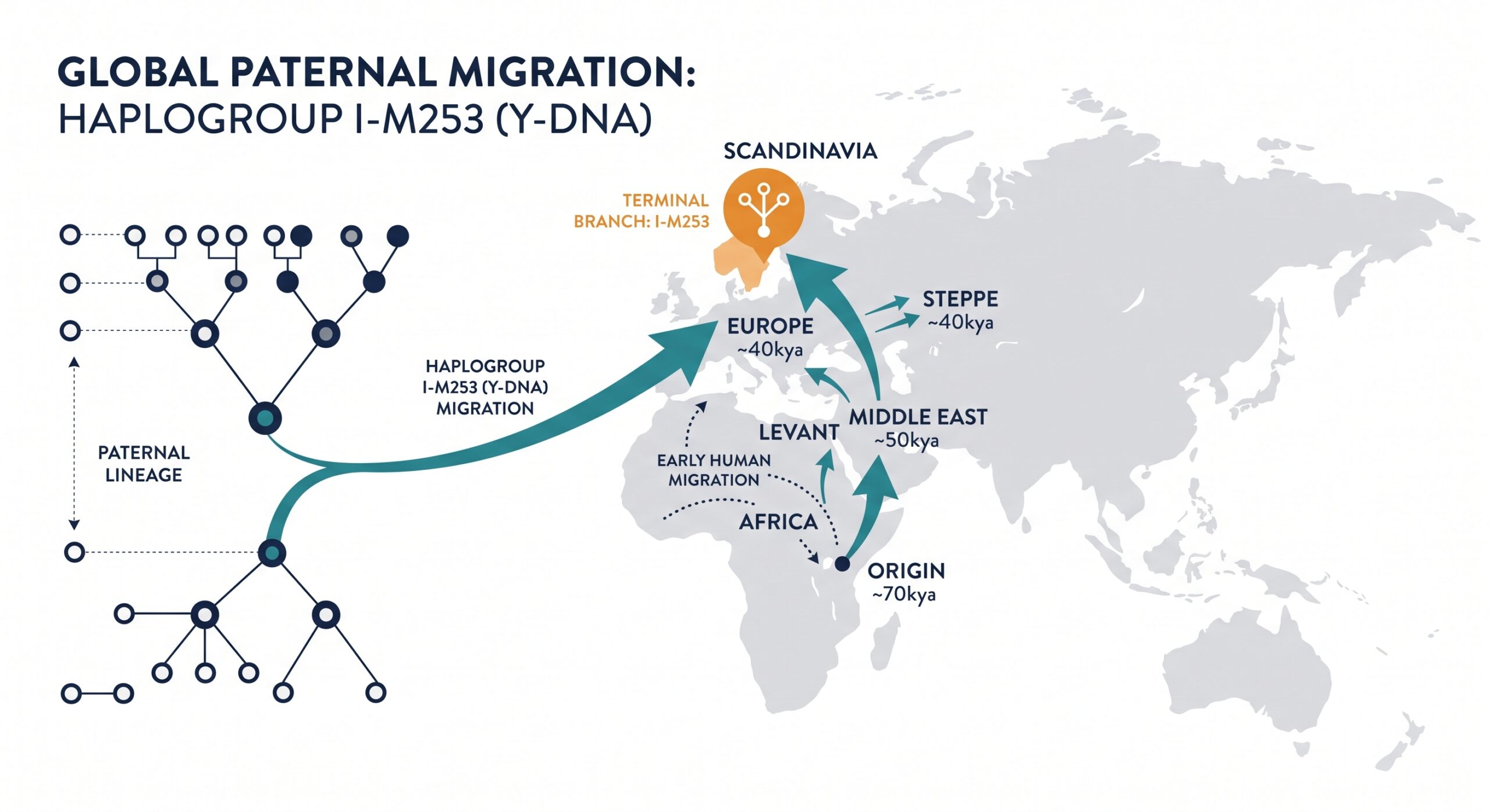
- Haplogroup: A major branch of the Y-DNA tree, defined by one or more shared derived SNPs and usually named with a capital letter (for example, R or I).
- Subclade: A smaller branch beneath a haplogroup. Subclades are commonly named with a haplogroup letter plus a defining SNP, such as I-M253.
- Terminal SNP: The furthest-down SNP on the known tree for which a tester is positive. It is a "moving target": as more men test and the tree grows, a tester's terminal SNP can change to a more specific one.
What a terminal SNP does not tell you: It does not give an exact date, and it does not identify a named historical ancestor. The age of a branch is an estimate calculated from the number of SNPs separating many testers, and the range can be wide. A terminal SNP can represent a branch that is only a few centuries old or one that is thousands of years old, depending on the part of the tree and how many men have tested. It can be a valuable clue, but it needs to be interpreted with a paper trail.
4. Understanding Genetic Distance Carefully
Genetic distance (GD) is the number of differences between two Y-DNA test results. For Y-STR comparisons, it is essentially a count of how many markers have different values. A genetic distance of zero means there are no differences at the markers that were compared, which ISOGG calls an exact match.
It is important to read that result correctly:
- Genetic distance of 0 does not prove a close relationship. It means two men share the same values at the markers tested. It makes a recent common paternal ancestor more likely, but it does not establish who that ancestor was, and it does not exclude a more distant link. For example, ISOGG states that for a perfect 37-marker match, there is roughly a 50% probability that the most recent common ancestor lived fewer than 2 to 3 generations ago, 90% fewer than 5, and 95% fewer than 7 (ISOGG). Those are probabilities, not guarantees.
- The test level matters. A genetic distance of 2 at Y-37 does not mean the same thing as a genetic distance of 2 at Y-111, because more markers give a more reliable comparison. FamilyTreeDNA's Learning Center provides interpretation guidance by test level.
- Mutations are random. Close relatives can differ, and distant relatives can match. Back mutations (a repeat count returning to its earlier value) and parallel mutations (the same change arising independently in unrelated lines) can also blur the picture.
- Surname context matters. Interpretation guidance is typically framed for men who share a surname. A low genetic distance between men with different surnames can be real evidence of a shared paternal line, but it may predate surnames, or reflect an undocumented adoption or name change.
Any estimate of "how many generations back" from genetic distance is a range with probabilities attached, not a single date.
5. Hypothetical Example: Two Men Named Miller Compare Y-STR Results
Scenario: Two men, Tester A and Tester B, both have the surname Miller. Their paper trails stop at different 19th-century Millers in different counties. Both take a Y-111 test at FamilyTreeDNA, and the match page shows a genetic distance of 2 out of 111 markers. The values below are invented to illustrate the idea and do not come from a real person or family.
| Marker (excerpt) | Tester A | Tester B | Difference? |
|---|---|---|---|
| DYS393 | 13 | 13 | No |
| DYS390 | 24 | 24 | No |
| DYS19 | 14 | 14 | No |
| DYS391 | 11 | 11 | No |
| DYS389II | 29 | 30 | Yes (1 step) |
| DYS458 | 17 | 18 | Yes (1 step) |
Excerpt only: the remaining markers in this imaginary Y-111 comparison match, giving a total genetic distance of 2.
How Tester A and Tester B might investigate:
- Treat the result as a hypothesis. A genetic distance of 2 at 111 markers makes a shared paternal ancestor plausible, but it does not name the ancestor or say exactly when he lived.
- Compare the paper trails. Look for overlapping places, occupations, migration routes, and the earliest documented Millers in each line, including spelling variants.
- Check the surname project and other matches. Do other Millers cluster with them? Do both men also match the same additional testers?
- Consider SNP testing. If both take a SNP test such as Big Y-700, they can see whether they share a terminal SNP or sit on the same recent branch, which adds evidence beyond STR similarity.
- Keep alternatives open. The common ancestor may pre-date the adoption of the surname, the match may reflect an undocumented adoption or name change, or similar STR values may have arisen by chance in unrelated lines.
6. STR vs. SNP at a Glance
| Feature | Y-STR (Short Tandem Repeat) | Y-SNP (Single Nucleotide Polymorphism) |
|---|---|---|
| Marker type | Repeating DNA sequence at a named location (DYS marker) | Single-letter change at one position in the DNA sequence |
| What is measured | The number of repeats at each marker (the haplotype) | Whether each position carries the ancestral or derived state (the haplogroup and terminal SNP) |
| Typical genealogical use | Comparing men with the same or similar surnames; calculating genetic distance; grouping surname project members | Placing a line on the Y-DNA tree; confirming whether men share a branch; separating distinct branches within a surname |
| Limitations | Mutation rates vary by marker; back and parallel mutations can mislead; results suggest a time range rather than an exact ancestor | Does not give an exact date or name an ancestor; terminal SNP changes as the tree grows; dating depends on statistical models and how many men have tested |
7. STR and SNP Results Work Best Together
STR and SNP results are complementary evidence. STRs are often the first screening tool for finding men who may share a recent paternal ancestor, while SNPs help confirm which branch of the tree those men belong to and separate lines that look similar by STRs alone. Neither replaces genealogical research. Interpret Y-DNA results together with your family tree, census and parish records, and other DNA evidence such as autosomal matches.
- Established facts: The Y-chromosome passes from father to son, STRs and SNPs are different kinds of markers, and SNP mutations are much rarer than STR mutations.
- Estimates: Generation ranges from genetic distance and branch ages from SNP counts are statistical estimates with wide margins.
- Interpretations: Deciding that two lines share a specific ancestor requires combining DNA with documents.
The true power of Y-DNA testing for genealogy is unlocked when you join a Surname DNA Project on FamilyTreeDNA (FTDNA). These are free, volunteer-run collaborative groups that gather Y-DNA data from men sharing the same last name (or phonetic variants). By grouping STR and SNP results, project administrators can reconstruct early lineages, assess which branches likely share a common ancestor, and help you narrow down where your brick-wall ancestor may connect in the old world.
Big Y-700 Testing: Combining STRs and SNPs for Deeper Paternal Research
Y-STR testing and Y-DNA SNP testing answer different questions about a paternal lineage. Big Y-700, offered by FamilyTreeDNA (FTDNA), is the product that combines both in one result. It is also the most data-heavy Y-DNA test most genealogists will ever see, so it helps to know what it adds, what it cannot do, and when a smaller test is the smarter choice. This section builds on the STR and SNP basics above rather than repeating them.
| FamilyTreeDNA product features (can change) | Independently established science (stable) |
|---|---|
| Big Y-700 reports more than 700 STRs and sequences hundreds of thousands of SNP positions; it includes the Y-37 and Y-111 results. | STRs mutate relatively often; individual SNPs mutate rarely and define branches of the Y-DNA tree. |
| Big Y Matches, the Block Tree, and Discover reports such as the Time Tree and Match Time Tree are FTDNA tools. | A shared derived SNP means two men descend from the same ancestral man on the paternal line, but not when or who he was. |
| FTDNA estimates the time to most recent common ancestor (TMRCA) between matches. | Any TMRCA is a statistical estimate with a wide range, and sparse data widens it further. |
Product details were checked against FTDNA’s Big Y-700 and Y-DNA pages on October 28, 2026. Features, test contents, and prices change, so confirm them before you order. We do not quote prices here.
What Big Y-700 Is and What It Is Designed to Investigate
According to FamilyTreeDNA, Big Y-700 uses both STRs and SNPs to connect a man to relatives and specific family lines, and to place him as precisely as current data allows on the Y-DNA haplotree. It is a test for genetic males, who carry a Y-chromosome. A woman who wants this information can ask a male relative on her father’s direct paternal line to test, as described in the Quick Fact box near the top of this article.
Big Y-700 is designed to help investigate questions such as:
- Which branch of the tree does my paternal lineage belong to, and how far down does it go today?
- Do two men with the same surname descend from one paternal ancestor, or from separate origins? SNP branches can separate lines that look alike by STRs.
- Could men with different surnames share a paternal ancestor? FTDNA lists linking recent genealogy to ancestors who lived before surnames, including matches with different surnames, among its stated aims.
- Where did one surname line split from another? Variants unique to a family line can point to the branching point.
It does not promise an answer to any of these. The outcome depends on who else has tested, how much of your line is documented, and what the records show.
How Big Y-700 Differs from Y-37 and Y-111 Testing
Y-37 and Y-111 are Y-STR tests. They compare 37 or 111 repeat markers. FTDNA states that Big Y-700 includes everything in Y-37 and Y-111 and adds 700+ STRs plus SNP sequencing. If you have already tested with FTDNA and your sample is stored, you may be able to add Big Y-700 from your account’s upgrade options rather than swabbing again.
Big Y-700 reads a large targeted part of the non-recombining Y-chromosome, not every base. Highly repetitive regions are hard to sequence reliably, so some positions are not usable in any one result.
The Complementary Roles of Y-STR Comparisons and Y-SNP Analysis
In practice, the two marker types do different jobs inside one Big Y-700 result:
- Y-STR testing is the quick screen. Because STRs change relatively often, a low genetic distance can flag men who may share a paternal ancestor within the surname era. The same property causes trouble: back mutations and parallel mutations can make unrelated lines look closer than they are.
- Y-DNA SNP testing is the structural check. A SNP that appears in one man’s line and is inherited by his male-line descendants marks a branch. Two men who share a derived SNP are on the same branch, and the tree shows where lines split.
- Together they cross-check each other. An STR match that is also a close SNP match is a stronger lead than either alone. An STR match that sits on a clearly different SNP branch is a warning sign.
The old rule of thumb, STRs for recent relationships and SNPs for deep ancestry, no longer holds neatly. FamilyTreeDNA’s own Big Y materials note that sequencing has found many SNPs that arose in recent generations, which is why Big Y can help with surname-era questions. Treat that as the vendor’s account of its product, and check it against your own matches.
How High-Resolution Y-SNP Results Refine Your Place on the Paternal Haplotree
A basic STR test predicts a broad haplogroup. Sequencing confirms the haplogroup and pushes the placement downward, to the furthest branch known at the time. FTDNA says branches gain definition as its database grows, and that a tester’s haplogroup is updated automatically as that happens. Your placement is therefore a snapshot, not a permanent label.
What These Terms Mean in Practical Genealogy
- Terminal SNP: the furthest-down named SNP for which you test positive today. Practically, it is the label you use to search for other men on your branch, in projects, and in published trees. It can change.
- Downstream branch: a branch below your terminal SNP. If you test positive for a named SNP that sits below another man’s terminal SNP, you are on a more specific branch than he is. Men on different downstream branches of the same parent branch share a more distant paternal ancestor than men on the same branch.
- Private variant: a SNP found in your results that has not yet been named or placed on the tree. FTDNA states that private variants help show when surname lines branched. In FTDNA’s workflow, a private variant is typically named and placed on the tree once it is found with high confidence in two or more testers. A variant seen in only one man could also be a sequencing read error, which is why shared variants carry more weight than lone ones.
Using Big Y Matches and the Block Tree to Investigate Paternal Lineages and Surname Connections
FTDNA describes the Block Tree as a view of how your paternal lineage relates to your matches’ lineages. It can show how matches are distributed by haplogroup, the country flags of their earliest known ancestors, and SNPs that are unique to particular surname lines. Big Y SNP Matches compares private variants to suggest where lines branched and to estimate the time to the most recent common ancestor.
A practical way to use these tools:
- Locate your block. Note your terminal SNP and the blocks above and beside it.
- Read the surnames and origins in nearby blocks. Repeating surnames or places suggest a family cluster. A mix of surnames suggests a link that predates surnames or an undocumented name change.
- Treat the earliest-ancestor data as clues. Flags and trees are self-reported by matches and may be missing, vague, or wrong.
- Compare shared and unshared variants with your closest matches to judge which line split first.
- Join the relevant projects. Surname, haplogroup, and geographic projects often hold records and context that match lists do not. Public project Group Time Trees are a Big Y-700 feature.
- Write down your hypothesis as a testable question for the records, not as a conclusion.
What you see depends on who has tested and how they share their results. A sparse branch may reflect few testers, not few relatives.
Hypothetical Case Study: Two Surnames, One Possible Paternal Lineage
Scenario: Tester A has the surname Thompson. His paper trail stops at John Thompson, born around 1790 in an English parish we will call Parish X. Tester B has the surname Hartley. His trail stops at Samuel Hartley, born around 1805 in neighboring Parish Y. Both take Big Y-700. Their results show a low STR genetic distance, the same terminal SNP, and a handful of private variants that differ. The names, places, and dates are invented for illustration.
How the two men could evaluate the result:
- Confirm the DNA basics. Check each man’s STR distance and the SNP differences between them. Look at whether the variants that differ are named or private, and whether coverage in those regions is reliable.
- Read the Block Tree around them. Do other testers on the same branch carry either surname, or a third one? Where do those testers’ earliest ancestors lived? A third surname appearing repeatedly would change the question.
- Estimate a range, not a date. A TMRCA tool will give a time range. If it spans both earlier and later than the 1790 and 1805 births, it cannot decide whether the link is recent or old.
- Compare the pedigrees on paper. Check the documented lines for gaps, single-source assumptions, or ancestors “identified” only by name similarity.
- Search records in the shared region. Look for baptisms, marriages, wills, land and tax records, apprenticeships, guardianships, and bastardy or settlement records for the area between Parish X and Parish Y. Look for neighbors, witnesses, and bondsmen who connect the two families.
- Test each explanation. The men may share an ancestor before surnames were fixed. An informal adoption, a name change, or an undisclosed birth may sit in one line. A family may have used different spellings or a patronymic before settling on a surname. One of the pedigrees may contain an error. Each explanation predicts different records.
What would strengthen the case: more men from both documented lines testing and landing on the same sub-branch, records that place the families in the same community, and a plausible event in the paper trail. What would weaken it: different branches once more men test, or records that firmly separate the families. Even a strong match would show that the two lines share a paternal ancestor, not who he was.
Who May Benefit from Big Y-700, and When a Less Expensive Test May Be Enough
Big Y-700 may be worth considering if you:
- Have a Y-STR match you cannot place and want to know whether you share a branch.
- Administer or belong to a surname or haplogroup project and need to separate branches within a surname.
- Have a paternal brick wall, an unknown father, or a suspected undocumented adoption, and want to see which branches your line could attach to. See DNA testing for adoptees for planning.
- Want your most refined haplogroup and are comfortable with results that evolve over time.
A smaller test may be enough if you:
- Only need to check whether two known male-line relatives match. FTDNA describes Y-111 as useful for confirming a relationship between two living men.
- Want a first look at surname matches and a predicted haplogroup. Y-37 is FTDNA’s entry-level option, and a stored sample can be upgraded later.
- Have few or no Y-DNA testers on your line yet. A larger test cannot compare you with men who have not tested.
- Have an autosomal question. Y-DNA only follows one line, so autosomal matching is usually the better tool for relatives outside it. See Part 2 and Part 5 of this series.
Prices and promotions change often, so compare current options on FamilyTreeDNA’s site before deciding.
Important Limitations of Big Y-700 Results
- TMRCA estimates are uncertain. A SNP-based time estimate is easy to calculate and easy to over-trust. Published analysis warns that estimates without confidence intervals can mislead, and that mutation-rate uncertainty and small mutation counts drive much of the error (McDonald). Tools that blend STRs, SNPs, and historical data narrow the range but do not remove it.
- Reference data are incomplete. Only part of the Y-chromosome is read reliably, and the tree reflects the men who have tested. Regions and surnames with few testers produce sparse branches, and results can shift as the database grows.
- Matches and trees depend on other people. Earliest-ancestor data are self-reported, and some matches share little or nothing.
- A haplogroup is not a nationality. A haplogroup or terminal SNP describes a paternal branch. It does not prove a modern nationality, a medieval group, or descent from a famous person, even when a report lists notable or ancient connections.
- Y-DNA follows one line. It says nothing directly about your other ancestors.
- A match is not a documented relationship. DNA can support a link. Records are what name the ancestor.
Big Y-700 FAQ
What is the difference between Big Y-700, Y-STR tests, and Y-DNA SNP testing?
Y-STR tests (Y-37, Y-111) count repeats at a set number of markers and are mainly used to compare men who may be related within recent centuries. Y-DNA SNP testing looks for single-letter changes that define branches of the tree. Big Y-700 is a sequencing test that includes the Y-37 and Y-111 results, more than 700 STRs, and broad SNP discovery, so it provides both kinds of evidence in one result. It is a product, whereas STR and SNP are marker types.
Does Big Y-700 include Y-37 and Y-111?
FamilyTreeDNA states that it does. If you already tested at a lower level with FTDNA, check your account for upgrade options.
Will Big Y-700 tell me who my ancestor was?
No. It can place your line on a branch and point to men who share it. Naming an ancestor requires documents, and matches only suggest where to look.
Do I need Big Y-700 to join a surname project?
No. FTDNA describes Y-111 as particularly useful for joining group projects. Big Y-700 helps once a project needs to separate branches.
Can a woman take Big Y-700?
Women do not have a Y-chromosome, so they cannot take a Y-DNA test. A male relative on the father’s direct paternal line can test instead.
Is my terminal SNP permanent?
No. As more men test, new branches are named and your terminal SNP may move to a more specific one.
To see how Y-DNA fits with autosomal and mtDNA results, continue to Part 5: Combining DNA Tests for Genealogy, or revisit the DNA foundations guides.
Sources for This Section
- FamilyTreeDNA: Big Y-700 product page – Product description, Block Tree, Big Y SNP Matches, and processing-time notes (checked Oct 28, 2026).
- FamilyTreeDNA: Y-DNA tests – Y-37, Y-111, and Big Y-700 comparison and FAQ (checked Oct 28, 2026).
- ISOGG Wiki: Y-chromosome DNA tests – STR and SNP testing background.
- ISOGG Wiki: Surname DNA projects – How projects use Y-DNA results.
- Irvine, J.M. (2021), Journal of Genetic Genealogy 9(1) – Y-DNA SNP-based TMRCA calculations and why confidence intervals matter.
- McDonald, I. – Improved models of coalescence ages of Y-DNA haplogroups – Sources of uncertainty in SNP-counting age estimates.
When to Deploy Y-DNA Testing in Your Research
Y-DNA is a highly specialized, forensic tool. You should strategically deploy it in your research when autosomal matches alone cannot resolve a paternal mystery:
1. Resolving Surname Brick Walls
If your paper trail ends with a grandfather born in 1820 sharing a common last name (such as "Smith" or "Andersson"), finding his parents through traditional records can be nearly impossible. A Y-DNA test can show which documented family branch your line most likely connects to, if men from that branch have tested. It can also show that your line is probably not related to other men with the same surname. Keep in mind that in some regions, such as Scandinavia, many surnames were adopted recently or were patronymic and changed each generation, so a shared surname is weaker evidence there.
2. Investigating Unknown Paternal Parentage
If you are an adoptee, or searching for an unknown biological father or grandfather, Y-DNA is an invaluable starting point. While autosomal matches help you cluster matches (see how to analyze DNA matches), your Y-DNA match list may contain men who carry the biological surname of your unknown father, provided that paternal relatives have tested. This can help you target your genealogical search on a specific surname branch. Review our dedicated guide on DNA testing for adoptees to plan your search.
3. Testing the Direct Paternal Line in Your Family Tree
To check that your documented paper tree is biologically consistent, Y-DNA testing can act as one line of verification. If you compare your results with a distant cousin who descends from your paternal 3rd-great-grandfather along a documented all-male line, a close Y-DNA match is consistent with an unbroken paternal line on both branches since that common ancestor. It does not verify the rest of your tree, and it cannot by itself rule out an undocumented event before the common ancestor.
A common mistake is treating deep Y-DNA haplogroups as direct proof of modern nationalities or specific historical groups (such as assuming carrying haplogroup R1b automatically proves "Viking roots" or "Irish heritage"). Broad haplogroups reflect ancient population history that often goes back many thousands of years, long before modern nations or medieval cultures existed. To investigate recent historical links, you must rely on high-resolution STR comparisons and terminal SNPs (such as those provided by Big Y-700), corroborated by traditional civil registers.
How to Integrate Y-DNA with Autosomal Matches and Records
To solve complex brick walls, Y-DNA should never be analyzed in isolation. The most powerful approach is to use Y-DNA as a forensic filter alongside autosomal matches and traditional registers:
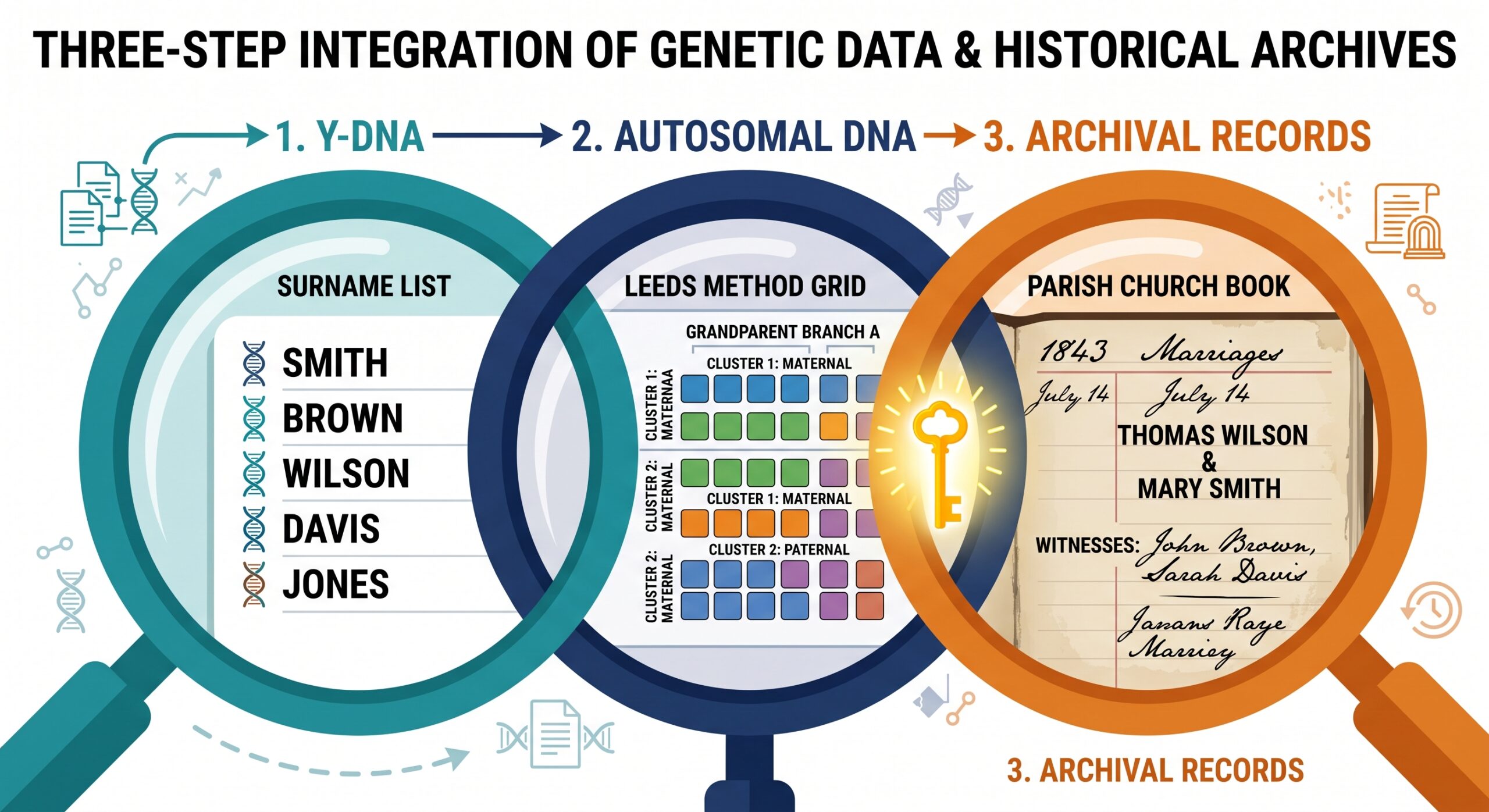
- Cluster Autosomal Matches: Sort and cluster your autosomal matches to identify paternal grandparent candidate branches. Download our Leeds Method templates from our free genealogy templates directory to group your autosomal matches quickly.
- Check Y-DNA Matches for Surnames: Scan your Y-DNA match list at FamilyTreeDNA for repeating surnames or shared terminal SNPs. If you find a cluster of matches sharing the surname "Miller" or the haplogroup "I-M253," you have identified a candidate paternal surname branch to test against records. Calculate relationship probabilities for autosomal matches using our online DNA Relationship Calculator.
- Verify with Archival Records: Once you have identified a shared surname and geographic region, explore localized archives. Search census rolls, tax registers, and parish church books to locate candidate families. Search regional archives using our curated directory of over 800 direct links in our global genealogy resources by country.
Frequently Asked Questions About Y-DNA Testing
Does AncestryDNA provide Y-DNA testing?
No. AncestryDNA, MyHeritage, and FamilyTreeDNA's Family Finder are autosomal DNA tests, which analyze Chromosomes 1 through 22. While 23andMe provides a basic, high-level paternal haplogroup prediction as part of their autosomal package, they do not provide a detailed Y-DNA match list or analyze specific STR/SNP markers. To get a Y-DNA match list and join Surname Projects, take a dedicated Y-DNA test at FamilyTreeDNA. Other labs also offer Y-chromosome sequencing, so check whether they provide a match database and surname projects before you order. Company features change, so confirm current offerings before you buy.
What is a “terminal SNP” and why does it matter?
A terminal SNP is the furthest-down SNP on the known Y-DNA tree for which you test positive. It defines your current position on the global paternal tree, and it can change as more men test and the tree is refined. Its age can range from recent to thousands of years, depending on the branch, and any date is a statistical estimate rather than a fact. A terminal SNP is most useful when other men with the same surname share it, because it can then support a link to a common paternal ancestor that you still need to confirm with records.
What is “pseudoautosomal” region DNA?
The pseudoautosomal regions (PAR1 and PAR2) are small segments at the tips of the X and Y chromosomes that do recombine during male meiosis. Genealogical Y-DNA tests focus on the male-specific region (MSY), which does not recombine with the X-chromosome, so paternal-line comparisons stay consistent from father to son.
Follow these five professional steps to begin mapping out your paternal line using Y-DNA:
- Order a dedicated Y-DNA test (Y-37 or Y-111 as a starting point) through FamilyTreeDNA.
- Identify your paternal haplogroup and locate your specific subclade on the global paternal tree.
- Join the free, volunteer-run Surname DNA Project representing your family last name on FTDNA.
- Review your matches at different STR levels, starting with the lowest Genetic Distance (GD) values, and remember that the same GD means different things at Y-37 and Y-111.
- Coordinate your Y-DNA findings with your autosomal matches and traditional paper registers using our free genealogy templates, and consider a SNP test such as Big Y-700 if you need to confirm branches.
Continue Your Genetic Voyage
Y-DNA testing is a powerful key that can help you investigate your paternal ancestry, test your surname line, and break through long-standing brick walls. By understanding paternal inheritance, evaluating genetic distance carefully, and joining Surname Projects, you can build a well-supported paternal story.
Ready to explore how these different test types are integrated into a single research strategy? Proceed to Part 5 of our series: Combining DNA Tests for Genealogy to learn how to integrate autosomal, Y-DNA, and mtDNA results into a single research strategy. Or, if you are ready to begin matching chromosomes visually, explore our online DNA Chromosome Browser utility.
Sources and Further Reading
- ISOGG Wiki: Y-chromosome DNA tests – Overview of STR and SNP testing, haplotypes vs. haplogroups, and example probabilities for 37-marker matches.
- ISOGG Wiki: Genetic distance – Definition of genetic distance, including that zero means no differences at the markers compared.
- ISOGG Wiki: Paths of DNA inheritance – Diagrams and explanations of Y-DNA and mtDNA inheritance paths.
- ISOGG Wiki: Y chromosome – Technical overview of the Y chromosome, including the male-specific region and non-recombination.
- ISOGG Wiki: Y-DNA project help – Guide to terminal SNPs, haplogroups, and Y-DNA project terminology.
- ISOGG Wiki: Surname DNA projects – How surname projects use Y-DNA to trace male lineages.
- ISOGG Wiki: Autosomal DNA statistics – Explanation of autosomal recombination and dilution across generations.
- ISOGG Wiki: Short tandem repeat and Single-nucleotide polymorphism – Definitions of the two marker types.
- FamilyTreeDNA Learning Center – Official documentation on Y-DNA STR matching, genetic distance interpretation by test level, and haplogroup naming.
- FamilyTreeDNA: Big Y-700 white paper – Technical description of the Big Y-700 SNP and STR test.
- FamilyTreeDNA: Big Y-700 – Product page describing high-resolution SNP discovery and haplogroup refinement.
- NHGRI: Y Chromosome Fact Sheet – National Human Genome Research Institute overview of Y chromosome structure and function.
- Forensic applications of Y chromosomal properties – Peer-reviewed article on the non-recombining nature of the Y chromosome and Y-STR/Y-SNP markers.
- ScienceDirect: Pseudoautosomal Region – Overview of the pseudoautosomal regions (PAR1 and PAR2) and their recombination during male meiosis.