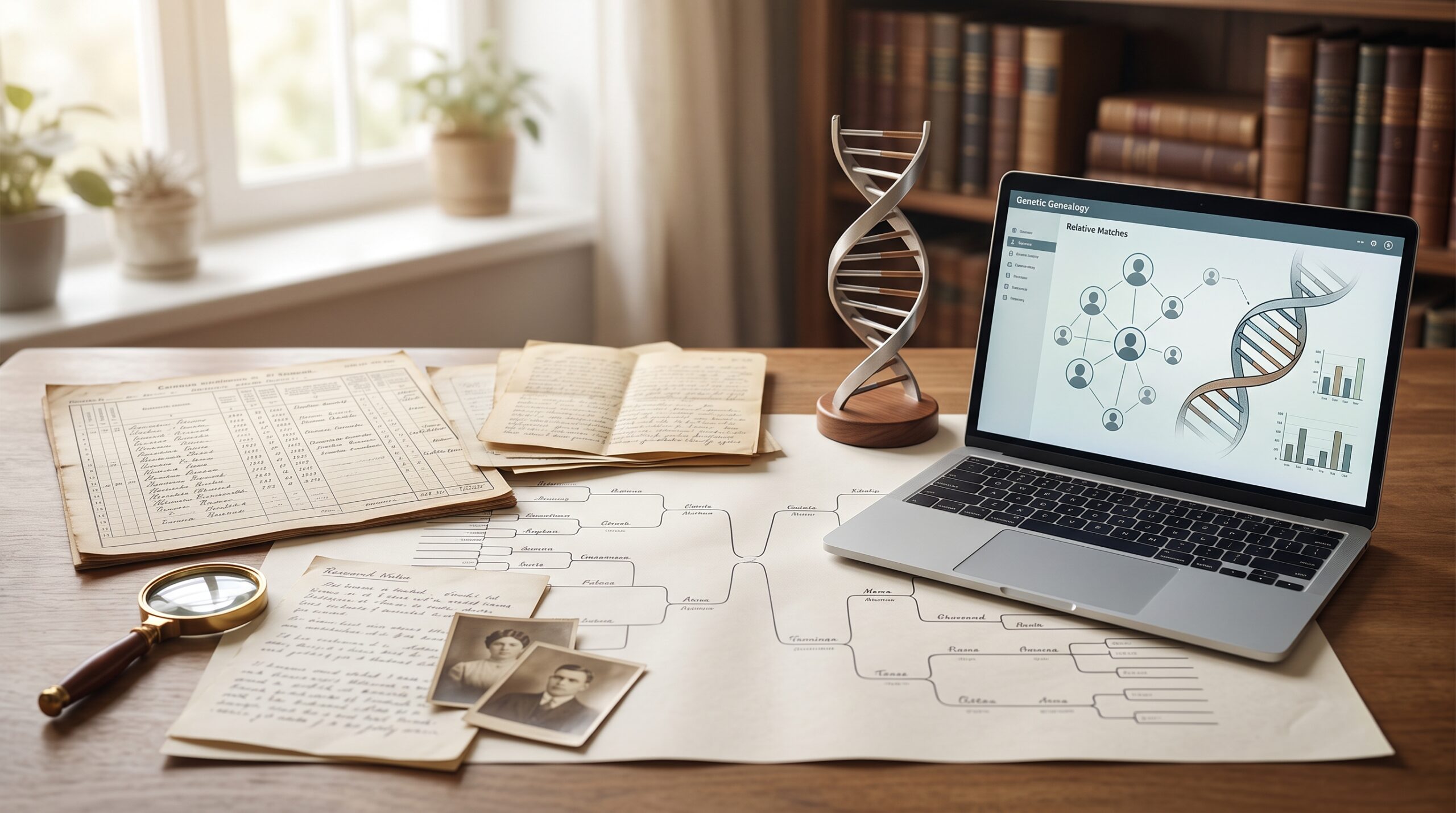
Some of the hardest genealogy problems can’t be solved by records alone. A missing parent, an unexplained surname, an undocumented relationship or a family that seems to vanish from the records can leave a researcher facing a genuine brick wall.
DNA testing doesn’t replace traditional genealogy, but used carefully it can add another line of evidence, helping you identify which documentary clues are worth chasing further.
Drawing on more than 30 years of traditional genealogical research and about 10 years working with genetic genealogy and DNA-based family research, this article lays out a practical hybrid method for combining documentary research, DNA matches, shared-segment evidence and hypothesis testing.
The idea isn’t to treat DNA as a shortcut to an answer, but to combine different types of evidence so each can help test and strengthen the other.
What Is a Genealogy Brick Wall?
A genealogy brick wall is a research problem where the available evidence doesn’t let you establish the next generation or resolve an important relationship.
Typical examples include:
- an unknown biological parent or grandparent,
- a child whose father or mother isn’t documented,
- an unexplained surname change,
- a family that disappears between two sets of records,
- an immigrant whose origin can’t yet be identified, or
- two families that appear connected but can’t be linked conclusively.
These problems are often difficult precisely because no single record answers the question. The solution usually has to come from several independent pieces of evidence pointing the same direction.
Step 1: Build the Documentary Foundation
DNA research works best when it starts from a clearly documented genealogical problem.
Before you touch your DNA matches, work out what the records actually tell you and exactly where the uncertainty begins.
Start with the known generations
Work backward from yourself using the strongest available records. Depending on the country and period, useful sources can include:
- civil registration records,
- parish and church registers,
- census returns,
- probate records and wills,
- land and property records,
- court records,
- military records,
- immigration and naturalization records, and
- contemporary newspapers and local directories.
Record the source for every important conclusion, and keep what a record actually states separate from your own interpretation of it.
Step 2: Organize Your DNA Matches
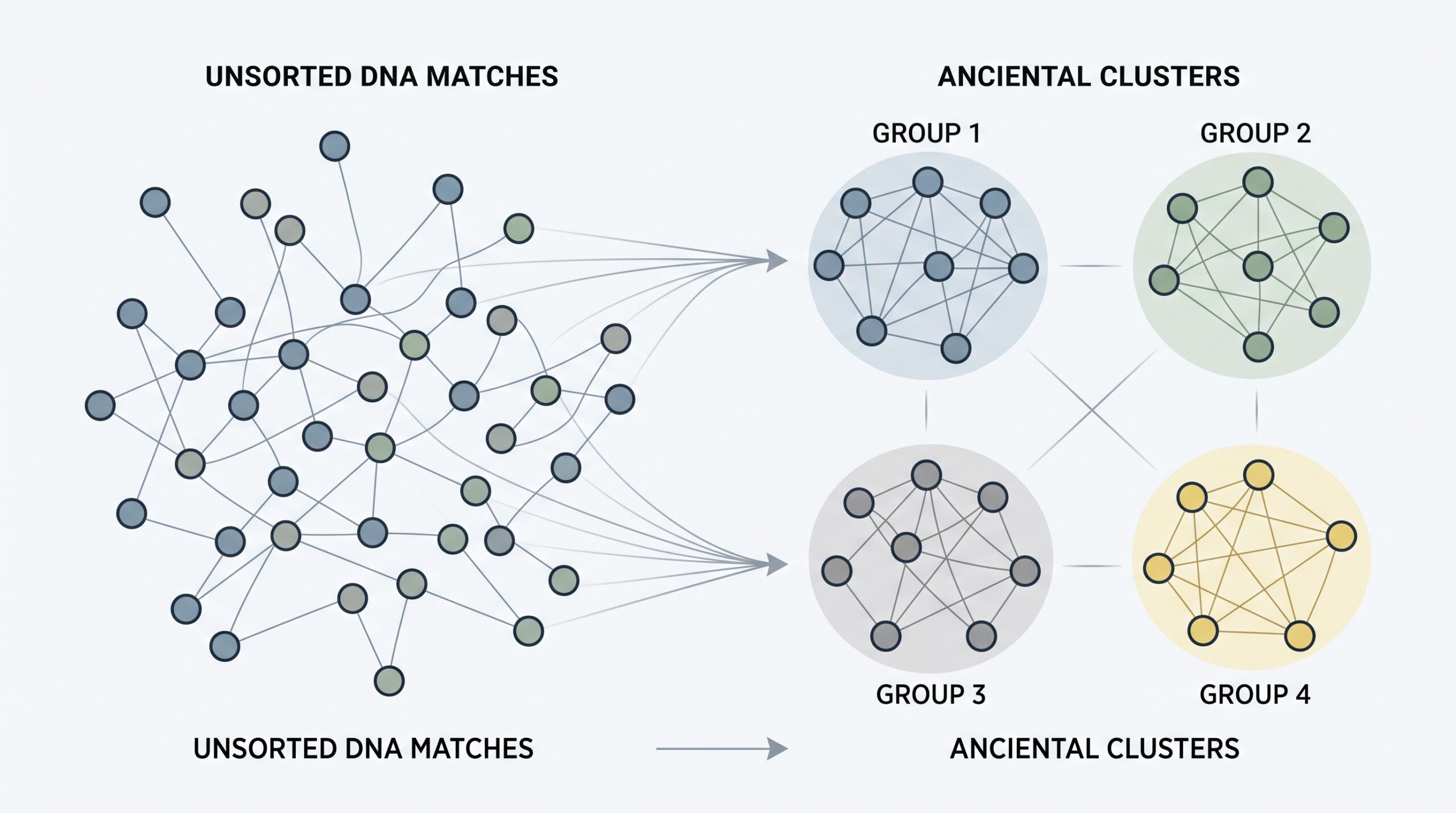
Once the documentary problem is clearly defined, turn to your DNA matches. The first challenge is organization. A large match list can run to hundreds or thousands of people, and reviewing them one at a time quickly becomes unworkable.
Clustering methods can help reveal groups of matches who may descend from different ancestral lines.
The Leeds Method
The Leeds Method, developed by Dana Leeds, is a practical way to sort DNA matches into groups based on shared matches. The resulting clusters can sometimes correspond to different grandparental or ancestral lines.
Treat it as an organizing framework, not a mathematical proof. Match thresholds and how useful a given cluster turns out to be depend on the testing platform, family structure and the research question at hand.
Learn more from Dana Leeds’ explanation of the Leeds Method .
AutoClusters and other clustering tools
Automated clustering performs a similar job at a larger scale. Tools like MyHeritage AutoClusters and Genetic Affairs can help you spot groups of matches who share DNA with one another.
Clusters won’t tell you which ancestor created the connection on their own. Their real value is turning a huge match list into more manageable research groups.
See MyHeritage AutoClusters and Genetic Affairs for more detail.
Which matches are worth pursuing?
Not every match on your list is a good use of research time. A few practical filters can help you focus on the matches most likely to move a specific brick wall forward:
- cM range for the question at hand. A match sharing 20–40 cM could represent dozens of possible relationships, so it’s rarely worth deep research on its own. For a recent brick wall (a missing parent or grandparent), prioritize matches in the closer ranges first and treat smaller matches as supporting evidence once you already have a hypothesis to test.
- Matches with an attached tree. Even a small, partially built tree gives you somewhere to start. Matches with no tree at all can still be useful, but usually only once you’ve identified a cluster they belong to.
- Shared surnames or locations. A match whose tree includes a surname or place already connected to your research is worth prioritizing over one with no obvious overlap.
- Matches who also match each other. A match that shares DNA with several other matches in the same cluster is more informative than an isolated match, since it helps confirm which ancestral line you’re looking at.
- Testers on multiple platforms. A match visible on more than one testing platform, or one you can also find in GEDmatch, gives you more shared-match data to work with.
The goal is to spend your limited research time on the matches most likely to answer your specific question, not to work through every match on the list in order.
Step 3: Build Research Trees
Once you’ve identified useful DNA match groups, dig into the people behind those matches.
Public family trees can offer valuable clues, but don’t treat them as proof. A tree may contain copied information, undocumented relationships or errors that have spread from one tree to another.
Use other people’s trees as research leads instead. Identify the ancestors that keep showing up across a cluster of matches, then verify those relationships against historical records.
Build quick research trees
You don’t always need to reconstruct an entire family tree. A small research tree is often enough to test a hypothesis.
For example, if several DNA matches appear to descend from the same couple, trace that couple’s descendants forward until you can see how they might connect to your own documented family.
This is where traditional genealogy and DNA research start reinforcing each other: DNA points you to people worth investigating, and records establish the actual documented relationships between them.
Step 4: Examine Shared DNA Segments
The amount of DNA shared with a match is usually expressed in centimorgans (cM). Closer biological relationships generally share more DNA, but the amount can vary quite a bit even within the same relationship category.
The DNA Painter Shared cM Project is a good reference for the ranges of DNA sharing you can expect across different relationships.
Treat shared cM as probabilistic evidence, not a definitive ID of a relationship.
Look beyond the total cM
Two matches can share a similar total amount of DNA while representing very different genealogical relationships. Endogamy and pedigree collapse can also cause people to share DNA through more than one ancestral path.
When you have it, chromosome-level information adds useful context.
Tools like the MyHeritage Chromosome Browser and DNA Painter’s tools can help you examine shared segments and organize the evidence.
Step 5: Use Triangulation Carefully
Shared segments get interesting when multiple testers share overlapping DNA on the same chromosome region and also match one another in that area.
This is commonly called a triangulated group.
Triangulation strengthens the case that a group of matches inherited DNA from a common ancestral source, but on its own it doesn’t identify the exact ancestor responsible for the segment.
Don’t lean on a single arbitrary segment-size threshold as a universal definition of “meaningful” DNA. How you interpret a segment depends on the research context, population history, testing platform and the other evidence you have.
Step 6: Compare Competing Hypotheses
A common mistake in difficult genealogy research is landing on one plausible explanation and stopping there.
A stronger approach is to lay out several possible relationships and ask which one best fits all the available evidence.
Use WATO as a hypothesis-testing tool
DNA Painter’s What Are The Odds? (WATO) is useful for weighing relationship hypotheses against your observed DNA data.
Don’t read its output as a universal probability that a genealogical hypothesis is historically true. The result depends entirely on the pedigree model and DNA evidence you feed it, and pedigree collapse or endogamy can complicate the underlying assumptions.
Other relationship models
For more complex pedigrees, tools like BanyanDNA can help you model relationships and see how different pedigree structures line up with your DNA observations.
These tools work best as analytical aids, not as automatic answer generators.
Step 7: Apply the Genealogical Proof Standard
DNA evidence should ultimately go through the same disciplined research process you’d use for documentary genealogy.
The Board for Certification of Genealogists describes the Genealogical Proof Standard as involving:
- reasonably exhaustive research,
- complete and accurate source citations,
- thorough analysis and correlation of evidence,
- resolution of conflicting evidence, and
- a soundly reasoned, coherently written conclusion.
This framework fits DNA cases particularly well, since genetic evidence rarely stands on its own. The strongest conclusions come from correlating DNA evidence with independently researched documentary evidence.
Important Limitations
Endogamy and pedigree collapse
Endogamy happens when people within a population or community repeatedly marry within the same group over multiple generations. Pedigree collapse happens when the same ancestor appears more than once in a person’s pedigree.
Both can create extra paths of genetic inheritance and make DNA relationships harder to read.
In these cases, shared DNA may reflect more than one ancestral connection, so don’t assume every shared segment traces to a single recent common ancestor.
Small DNA segments
Smaller shared segments can still be useful, but they need more careful interpretation, since the odds of a coincidental match rise as segments get smaller.
There’s no single segment-size cutoff you can treat as a universal proof threshold for every genealogical question.
DNA does not replace records
A DNA match suggests two people share biological ancestry. It doesn’t by itself pin down the exact relationship, identify a particular ancestor, or prove a parentage hypothesis.
Documentary evidence is still essential for reconstructing the historical path between generations.
Common mistakes when interpreting DNA matches
- Stopping at the first plausible explanation. A hypothesis that fits the evidence isn’t the same as the only hypothesis that fits the evidence. Always test alternatives before settling on one (see Step 6).
- Treating total shared cM as proof of a specific relationship. The same cM total can fit several different relationships. Use it to narrow the range, not to name the exact relationship.
- Assuming a single shared segment means a single common ancestor. Endogamy and pedigree collapse can produce shared DNA through more than one ancestral path at once.
- Trusting public trees without verification. Copied errors spread quickly between online trees. Use them as leads, not as sources.
- Relying on a fixed segment-size cutoff as a universal rule. What counts as a meaningful segment depends on the research context, not a single number that applies everywhere.
- Skipping the documentary research. A DNA match tells you two people share ancestry. It doesn’t tell you how, when, or through whom, until you verify it against records.
A Repeatable Hybrid Workflow
The method boils down to a practical research cycle:
- Define the brick wall. State exactly what relationship or generation is unknown.
- Research the known family. Build the strongest documentary foundation you can.
- Identify relevant DNA matches. Focus on matches that could plausibly relate to your research question.
- Cluster the matches. Use shared matches and clustering tools to identify groups.
- Build research trees. Trace promising matches and ancestral families through the records.
- Examine shared segments. Where you can, compare chromosome-level evidence.
- Look for triangulation. Check whether multiple testers share the same relevant segment.
- Form competing hypotheses. Don’t assume the first plausible explanation is the right one.
- Model the evidence. Use tools like WATO or BanyanDNA where it makes sense.
- Return to the records. Test the DNA-based hypothesis against historical evidence.
- Resolve conflicts. Chase down evidence that doesn’t fit your preferred hypothesis.
- Write the conclusion. Clearly separate documented facts, DNA evidence, analysis and remaining uncertainty.
The important part is that this is a cycle, not a one-way process. DNA can send you back to the records, and records can send you back to the DNA. Each one changes the questions you ask of the other.
DNA, Privacy and Ethics
Genetic genealogy touches information about living people as well as historical ancestors, so think about privacy and consent throughout the process.
Avoid publishing identifying information about living relatives or DNA testers without their permission, especially in case studies, screenshots, match information or unexpected biological relationships.
When you write about DNA research publicly, anonymized examples and conceptual diagrams are usually the safer choice, unless the people involved have explicitly agreed to publication.
It’s also worth reviewing the current terms, privacy policies and sharing settings of whatever DNA services you use.
Useful Tools for the Hybrid Method
- Dana Leeds’ Leeds Method : a practical framework for organizing DNA matches into groups.
- DNA Painter : tools for shared DNA, relationship analysis and chromosome mapping.
- DNA Painter Shared cM Project : reference information for interpreting shared DNA amounts.
- DNA Painter WATO : a tool for comparing relationship hypotheses.
- MyHeritage DNA : DNA matching and genetic genealogy tools.
- MyHeritage AutoClusters : automated organization of DNA matches into groups.
- Genetic Affairs : tools for working with DNA match data and clustering.
- GEDmatch : additional genetic genealogy comparison and analysis tools.
- BanyanDNA : pedigree and DNA relationship modeling tools.
Sources and Further Reading
- Board for Certification of Genealogists: Ethics and Standards
- Board for Certification of Genealogists: Genealogy Standards, Second Edition
- Dana Leeds: The Leeds Method
- DNA Painter: Shared cM Project
- DNA Painter: WATO
- MyHeritage: AutoClusters
- MyHeritage: Chromosome Browser
- BanyanDNA
DNA testing platforms and third-party tools change over time. Always check the current documentation, terms and privacy policies of the services you use.
Conclusion
The most effective way to approach a difficult genealogy brick wall is rarely to choose between traditional genealogy and DNA.
Use them together instead.
Records establish the documented history. DNA provides evidence of biological relationships. Research connects the two.
Organize your DNA matches systematically, investigate research trees carefully, interpret shared segments cautiously, test competing hypotheses and correlate documentary evidence with genetic evidence, and questions that once seemed unsolvable can become a lot more tractable.
The goal isn’t to make DNA hand you an answer. It’s to build the strongest, most transparent conclusion the available evidence can actually support.
Editorial Note
The tools and services mentioned in this article are provided by independent organizations and may change over time. Check the current documentation of each service for the latest features, terminology, availability and privacy policies.