Introduction
You’re staring at your list of DNA matches. You’ve formed a hypothesis: “Maybe this person is my unknown half-cousin on my mother’s side?” But how do you test whether that hypothesis actually holds up, not just roughly or but with the logic of the entire genetic puzzle? That’s where two of the most powerful and often misunderstood tools in genetic genealogy come in: WATO and BanyanDNA.
If you move in the world of DNA research, you’ve probably heard of WATO (What Are The Odds?). It’s the go-to tool for setting up and comparing alternative relationship hypotheses. But when BanyanDNA arrived on the scene, something fundamental shifted. Suddenly we could not just explore where someone might fit in a tree and we could test whether an entire proposed family structure actually fits the DNA evidence.
In this post, we’ll break down the difference, show how the tools complement each other, and give you a practical mindset for taking the next step in your toughest DNA cases. Whether you’re working on unknown parentage, an adoptee’s origins, or a tangled family tree full of double cousins and pedigree collapse, you’ll come away with a clear roadmap.
The Basics: What Are WATO and BanyanDNA?
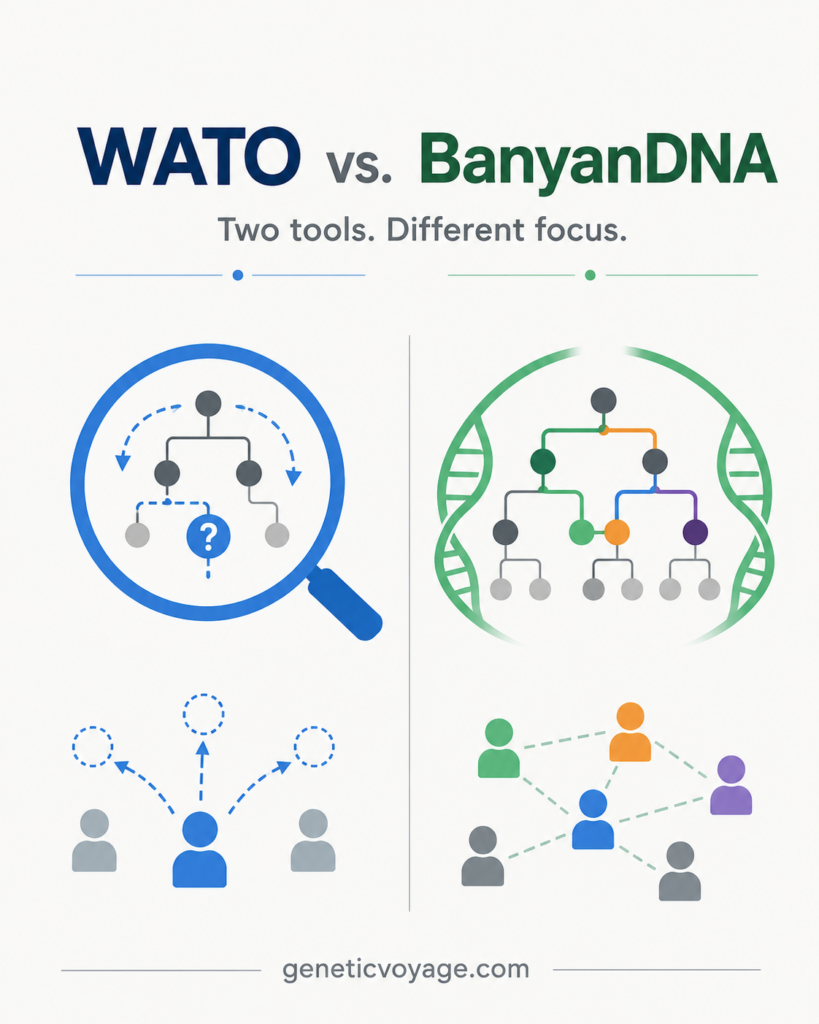
Both tools use shared centimorgans (cM) between a test-taker and several DNA matches to evaluate relationship hypotheses. But they ask fundamentally different questions which is precisely why they are so valuable together.
 WATO (What Are The Odds?) – available at DNA Painter – asks:
“Where could this person fit in my family tree?”
You feed in cM values for a set of known matches, specifying how they are related to each other in the tree. Then you let WATO test different possible positions for an unknown person – a “mystery match” – relative to those known individuals. The tool returns a ranked list of hypotheses, ordered by how likely they are given the observed DNA sharing. For a deep dive into the mechanics of shared cM and relationship probabilities, read our guide: Understanding Shared DNA Segments.
 BanyanDNA – created by genetic genealogist Leah Larkin – asks instead:
“Does my proposed family structure actually fit the DNA evidence?”
Here, you first build a complete hypothesis of the entire family structure – including all assumed relationships – and then let BanyanDNA model how DNA would be inherited inside that specific structure. The tool simulates inheritance across many generations and handles complex situations that break simpler models:
-
- Half relationships (e.g. half-siblings, half-cousins)
-
- Pedigree collapse (when the same ancestor appears in multiple places in the tree)
-
- Double cousins (when two siblings marry two siblings from another family)
-
- Multiple paths of relatedness between the same two people
-
- Unknown ancestors that must be modelled as “placeholders”
The result shows whether the observed cM sharing is consistent with your hypothesis, unlikely, or even outright impossible. If you’re new to building these kinds of multi-generation models, our Introduction to Chromosome Browsers and DNA Modelling gives you the foundational skills.
WATO = Explore the Possibilities, BanyanDNA = Test the Structure
Think of WATO as your compass when you’re feeling around in the dark. You don’t know where a particular match belongs, but you have several confirmed relatives as reference points. WATO suggests the most probable spots and ranks them – invaluable at the start of a case with unknown origins.
BanyanDNA, on the other hand, is the laboratory where you stress-test your complete model. Once you have a working hypothesis: “I think my biological grandfather is X, and this match is the grandchild of my half-aunt”, you build the entire structure and test whether the cM amounts for all involved people are compatible with it. The tool flags inconsistencies and can reveal that your neat hypothesis falls apart – or confirms that everything fits together beautifully.
This combination is especially powerful when dealing with endogamy or multiple connections. Read our case study on untangling pedigree collapse: Breaking Genealogy Brick Walls with DNA.
When to Use Which? A Practical Mindset
Here’s a workflow that many experienced genetic genealogists use:
-
- Start with WATO
You have a high-interest DNA match whose place in the tree is unknown. Identify a handful of secure relatives on the same branch (ideally from different generations) and run WATO. The output gives you a shortlist of plausible relationships. Already at this stage you can often rule out impossible scenarios and focus your documentary research. To make sure you’ve clustered your matches correctly before feeding them into WATO, follow our step-by-step Leeds Method guide.
- Start with WATO
-
- Build a complete family hypothesis
Based on WATO’s suggestions and traditional genealogical records (vital records, censuses, probates), formulate a full hypothesis: “Person A is the child of B and C, who are half-siblings to D…” and so on. Draw out the entire tree structure.
- Build a complete family hypothesis
-
- Test the structure with BanyanDNA
Enter your hypothesis into BanyanDNA together with all relevant DNA matches and their measured cM values. Let the tool model the inheritance. Here you get the answer to the crucial question: Can this family structure really produce the DNA amounts we observe? Or does it require something else – an extra half-relationship, an unknown sibling, a double connection?
- Test the structure with BanyanDNA
-
- Iterate
If BanyanDNA shows the hypothesis is improbable, adjust and test again. Maybe you move a person, add an unknown ancestor, or incorporate pedigree collapse. In this way you approach, step by step, the structure that best explains all available evidence. To see how this iterative process works in a real adoption case, don’t miss our comprehensive resource DNA Testing for Adoptees: Strategies for Solving Unknown Heritage.
- Iterate
Example: When WATO Isn’t Enough – and BanyanDNA Steps In
Imagine you’re trying to place a DNA match of 400 cM. WATO suggests several possibilities: a half-sibling, an aunt/uncle, a double cousin. You find a likely placement as a half-aunt on your father’s side – but you know there is pedigree collapse in your father’s branch: his parents were second cousins. WATO cannot fully model that extra shared DNA. This is where BanyanDNA enters: you build the entire branch, including the double ancestor, and simulate the cM ranges for a half-aunt in exactly that structure. The result shows that 400 cM is perfectly plausible – but that 200 cM for another match on the same branch is not. You are forced to revise the hypothesis, and after a few iterations, the pieces fall into place.
Tools and Resources to Get Started
-
- WATO is available at DNA Painter (free basic version; premium unlocks additional features). For a tour of the entire DNA Painter suite, see our post: DNA Painter: Painting Your Chromosomes and Using WATO Step by Step.
-
- BanyanDNA can be found at banyan-dna.com, which offers various subscription levels. Begin by exploring the free example cases to understand the modelling mindset.
-
- To group your matches before feeding them into either tool, automated clustering solutions can be a huge time-saver. Learn about them in Automated Clustering with Genetic Affairs.
-
- If you are completely new to DNA test interpretation, start with our foundational guide: DNA Testing Basics for Beginners.
Conclusion – and Your Next DNA Challenge
WATO and BanyanDNA are not competitors; they are partners in solving genealogical mysteries. WATO opens the door to the landscape of possibilities. BanyanDNA closes the door on hypotheses that don’t hold up – and confirms the ones that do. By using both, you move from fragmentary cM numbers to a coherent family narrative that explains all the DNA evidence.
 Which tool have you used?
– WATO
– BanyanDNA
– Both
– Neither yet, but now I’m curious!
Comment below and share your experience – or your most stubborn DNA brick wall right now.
 Like this post if you want to see more DNA tool comparisons.
 Bookmark this for the next time you encounter a match that refuses to fit.
Follow @geneticvoyage for more strategies, tool guides, and real-world case studies in genetic genealogy.
Explore more at geneticvoyage.com:
-
- Leeds Method: Clustering Your DNA Matches (coming soon)
Your journey towards genetic clarity begins with the right question. Ask it with the right tool.
≈
Introduction
You’re staring at your list of DNA matches. You’ve formed a hypothesis: “Maybe this person is my unknown half-cousin on my mother’s side?” But how do you test whether that hypothesis actually holds up – not just roughly, but with the logic of the entire genetic puzzle? That’s where two of the most powerful – and often misunderstood – tools in genetic genealogy come in: WATO and BanyanDNA.
If you move in the world of DNA research, you’ve probably heard of WATO (What Are The Odds?). It’s the go-to tool for setting up and comparing alternative relationship hypotheses. But when BanyanDNA arrived on the scene, something fundamental shifted. Suddenly we could not just explore where someone might fit in a tree – we could test whether an entire proposed family structure actually fits the DNA evidence.
In this post, we’ll break down the difference, show how the tools complement each other, and give you a practical mindset for taking the next step in your toughest DNA cases. Whether you’re working on unknown parentage, an adoptee’s origins, or a tangled family tree full of double cousins and pedigree collapse, you’ll come away with a clear roadmap.
The Basics: What Are WATO and BanyanDNA?
Both tools use shared centimorgans (cM) between a test-taker and several DNA matches to evaluate relationship hypotheses. But they ask fundamentally different questions – which is precisely why they are so valuable together.
WATO (What Are The Odds?) – available at DNA Painter – asks:
“Where could this person fit in my family tree?”
You feed in cM values for a set of known matches, specifying how they are related to each other in the tree. Then you let WATO test different possible positions for an unknown person – a “mystery match” – relative to those known individuals. The tool returns a ranked list of hypotheses, ordered by how likely they are given the observed DNA sharing. For a deep dive into the mechanics of shared cM and relationship probabilities, read our guide: Understanding Shared DNA Segments.
BanyanDNA – created by genetic genealogist Leah Larkin – asks instead:
“Does my proposed family structure actually fit the DNA evidence?”
Here, you first build a complete hypothesis of the entire family structure – including all assumed relationships – and then let BanyanDNA model how DNA would be inherited inside that specific structure. The tool simulates inheritance across many generations and handles complex situations that break simpler models:
-
- Half relationships (e.g. half-siblings, half-cousins)
-
- Pedigree collapse (when the same ancestor appears in multiple places in the tree)
-
- Double cousins (when two siblings marry two siblings from another family)
-
- Multiple paths of relatedness between the same two people
-
- Unknown ancestors that must be modelled as “placeholders”
The result shows whether the observed cM sharing is consistent with your hypothesis, unlikely, or even outright impossible. If you’re new to building these kinds of multi-generation models, our Introduction to Chromosome Browsers and DNA Modelling gives you the foundational skills.
WATO = Explore the Possibilities, BanyanDNA = Test the Structure
Think of WATO as your compass when you’re feeling around in the dark. You don’t know where a particular match belongs, but you have several confirmed relatives as reference points. WATO suggests the most probable spots and ranks them – invaluable at the start of a case with unknown origins.
BanyanDNA, on the other hand, is the laboratory where you stress-test your complete model. Once you have a working hypothesis – “I think my biological grandfather is X, and this match is the grandchild of my half-aunt” – you build the entire structure and test whether the cM amounts for all involved people are compatible with it. The tool flags inconsistencies and can reveal that your neat hypothesis falls apart – or confirms that everything fits together beautifully.
This combination is especially powerful when dealing with endogamy or multiple connections. Read our case study on untangling pedigree collapse: Breaking Genealogy Brick Walls with DNA.
When to Use Which? A Practical Mindset
Here’s a workflow that many experienced genetic genealogists use:
-
- Start with WATO
You have a high-interest DNA match whose place in the tree is unknown. Identify a handful of secure relatives on the same branch (ideally from different generations) and run WATO. The output gives you a shortlist of plausible relationships. Already at this stage you can often rule out impossible scenarios and focus your documentary research. To make sure you’ve clustered your matches correctly before feeding them into WATO, follow our step-by-step Leeds Method guide (coming soon).
- Start with WATO
-
- Build a complete family hypothesis
Based on WATO’s suggestions and traditional genealogical records (vital records, censuses, probates), formulate a full hypothesis: “Person A is the child of B and C, who are half-siblings to D…” and so on. Draw out the entire tree structure.
- Build a complete family hypothesis
-
- Test the structure with BanyanDNA
Enter your hypothesis into BanyanDNA together with all relevant DNA matches and their measured cM values. Let the tool model the inheritance. Here you get the answer to the crucial question: Can this family structure really produce the DNA amounts we observe? Or does it require something else, an extra half-relationship, an unknown sibling, or a double connection?
- Test the structure with BanyanDNA
-
- Iterate
If BanyanDNA shows the hypothesis is improbable, adjust and test again. Maybe you move a person, add an unknown ancestor, or incorporate pedigree collapse. In this way you approach, step by step, the structure that best explains all available evidence. To see how this iterative process works in a real adoption case, don’t miss our comprehensive resource DNA Testing for Adoptees: Strategies for Solving Unknown Heritage.
- Iterate
Example: When WATO Isn’t Enough – and BanyanDNA Steps In
Imagine you’re trying to place a DNA match of 400 cM. WATO suggests several possibilities: a half-sibling, an aunt/uncle, a double cousin. You find a likely placement as a half-aunt on your father’s side – but you know there is pedigree collapse in your father’s branch: his parents were second cousins. WATO cannot fully model that extra shared DNA. This is where BanyanDNA enters: you build the entire branch, including the double ancestor, and simulate the cM ranges for a half-aunt in exactly that structure. The result shows that 400 cM is perfectly plausible but that 200 cM for another match on the same branch is not. You are forced to revise the hypothesis, and after a few iterations, the pieces fall into place.
Tools and Resources to Get Started
-
- WATO is available at DNA Painter (free basic version; premium unlocks additional features). For a tour of the entire DNA Painter suite, see our post: DNA Painter: Painting Your Chromosomes and Using WATO Step by Step.
-
- BanyanDNA can be found at banyan-dna.com, which offers various subscription levels. Begin by exploring the free example cases to understand the modelling mindset.
-
- To group your matches before feeding them into either tool, automated clustering solutions can be a huge time-saver. Learn about them in Automated Clustering with Genetic Affairs.
-
- If you are completely new to DNA test interpretation, start with our foundational guide: DNA Testing Basics for Beginners.
Conclusion and Your Next DNA Challenge
WATO and BanyanDNA are not competitors; they are partners in solving genealogical mysteries. WATO opens the door to the landscape of possibilities. BanyanDNA closes the door on hypotheses that don’t hold up and confirms the ones that do. By using both, you move from fragmentary cM numbers to a coherent family narrative that explains all the DNA evidence.
Which tool have you used?
– WATO
– BanyanDNA
– Both
– Neither yet, but now I’m curious!
Comment below and share your experience – or your most stubborn DNA brick wall right now.
Like this post if you want to see more DNA tool comparisons. Bookmark this for the next time you encounter a match that refuses to fit.
Follow @geneticvoyage for more strategies, tool guides, and real-world case studies in genetic genealogy..
Explore more at geneticvoyage.com:
-
- Leeds Method: Clustering Your DNA Matches (coming soon)
Your journey towards genetic clarity begins with the right question. Ask it with the right tool.